

Matt Goodwin’s newsletter goes to 94,000 subscribers. Inner Circle & Paid subscribers can access every post, the archive, comments, join Matt live every Friday, and support an independent writer who speaks up for the silent majority. Join us on YouTube, Instagram, X and Facebook. We will always tell you truth. Support us by upgrading or donating.
Here are three seemingly separate stories you might have missed in the last week that, taken together, reveal something far more profound.
First, it has emerged that pro-immigration campaigners helped place and prepare illegal migrants in the audience on the BBC flagship debate programme, Question Time, to “test” pro-migration messages in front of the British people.
Second, at the same time, it’s been revealed that a writer who helped craft storylines on the popular BBC primetime soap Eastenders is a “migration and racial justice” activist who works on “changing people’s views” through popular culture.
And third, it’s quietly been revealed that the family of Rhiannon Whyte — a young mother who was stabbed to death by an illegal migrant from Sudan — was guided by state officials to “tone down” their statement after Rhiannon’s murder, because of fears it might cause unrest among the wider population.
Three seemingly different stories that involve three different institutions – the BBC, the creative industry, and the British state. What do they all have in common?
All three, I would suggest, reflect the rise of what I call the ‘Narrative State’ – a state that along with its ruling class and institutions no longer sees its main role as being to describe reality but rather to present a socially-engineered, alternate vision of reality that both reflects and reinforces its dominant ideology.
In the Narrative State, bureaucrats, politicians, and institutions appear much less concerned with governing society itself than with governing how society is perceived by its citizens. The aim is not to present a realistic portrayal of what is happening around us but, instead, to present society as the ruling class believe it ought to be.
On one level, we saw this reflected in how the creative class and the British state united around the Netflix drama Adolescence, aggressively pushing a deeply warped vision of reality in which we were invited to believe that the main threat to British society is posed by white boys from stable homes.
We also saw it reflected in the findings of a recent study which found that while black people represent only 4 per cent of the population in England and Wales they appear in close to 50 per cent of all advertisements on television — a deliberate distortion of reality so that it better reflects what the ruling class would like to see.
But on a deeper level it is also clear that something far more insidious is at work. Increasingly, the Narrative State is now using an assortment of legacy media, universities, charities, the creative industries, state broadcasters, and shadowy government communications units to try and influence public perceptions through “framing”, “nudges”, “narrative control”, aggressive censorship, and speech codes.
Constantly fearing a loss of control, constantly trying to retain its power, the Narrative State is continuously trying to influence which facts are emphasised, which voices or ‘experts’ are amplified or discredited, which arguments are considered legitimate, and which conclusions citizens are allowed and encouraged to draw.
Compare and contrast, for example, the British state’s response to the Henry Nowak and Rhiannon Whyte murders. Henry Nowak’s father, who called for greater action on knife crime, was amplified by the state and legacy media. Rhiannon Whyte’s mother, who called on the state to fix its broken borders and stop illegal migration — goals that were not consistent with the dominant ideology of the state — was ignored.
For years, the ruling class denied this was happening at all. The mere suggestion that we might be living in some kind of socially constructed reality was dismissed as the stuff of ‘conspiracy theory’, ‘paranoia’, or ‘extremism’. But as the gap between people’s lived reality and what they are being told by the state has morphed into an enormous gulf — especially when it comes to mass immigration, demographic change, Islamism, and crime — this denial has become impossible to sustain.
Put simply, millions of people now sense they are not being told the full story. Worse: they now sense they are being subjected to social engineering and manipulated by the very politicians and bureaucrats who are supposed to tell them the truth.
And they’re not wrong to think this way.
In recent weeks, even major newspapers in Britain, such as the Daily Mail, reported on the shadowy government units whose sole job is to manage public perceptions in the shadow of Islamist attacks and atrocities that often involve immigrants and minorities.
Only a few weeks ago, that newspaper drew attention to the ‘Research, Information, and Communications Unit’, or RICU, which it notes uses an assortment of methods to manage the ‘challenges’ that arise from mass immigration and broken borders:
“Its techniques”, wrote the investigators, “range from planting stories in the media, using undercover operatives to lay flowers at the scene of terrorist attacks and even, in one case, sending a pop group to sing anti-extremist songs in Muslim schools … They are working with the Police Service of Northern Ireland's C3 intelligence unit to identify those posting the online 'calls to protest' in Belfast [after the latest hideous attack] and other areas, as well as giving strategic messages to the police to ensure that the protesters were portrayed as unsympathetic thugs, rather than activists, and effecting behavioural change”.
In the immediate aftermath of horrifying Islamist attacks in London, in 2017, the same state unit reportedly drove around the area plastering walls with hashtags that read #TurnToLove, #ForLondon and #LoveWillWin.
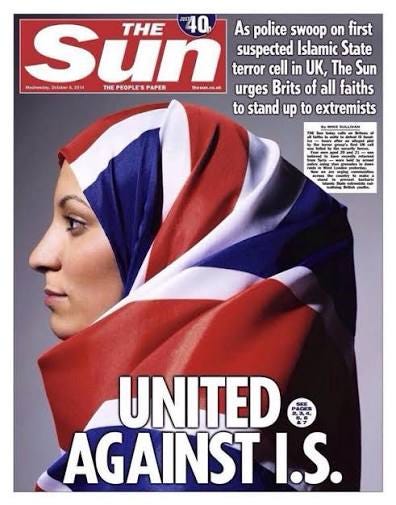
And after the grotesque beheading of British aid worker Alan Henning, in 2014, by Islamic State, the same unit reportedly used a ‘front operation’ to plant an image of a woman in a Union Jack hijab in legacy media.
What all this reflects is how the goal of the Narrative State is not only to ‘win’ national debates or ‘control the narrative’ but, at a deeper level, shape and influence the wider environment in which these debates take place to begin with.
When public concern over, say, immigration increases, the Narrative State no longer replies by asking whether that concern is justified, or responding to it. Instead, it works overtime to ‘manage’ or ‘reframe’ that concern, while trying to ‘nudge’ citizens to a different conclusion — one that does not threaten the regime and its ideology.
Time and time again — the murder of Sir David Amess, the Manchester Arena bombing, the Westminster Islamist attacks, the Pakistani Muslim grooming gangs, and the pro-migration statement that was issued by family members after the recent attempted beheading of their relative in Belfast — the goal of the Narrative State is not to address the grievance but try and police the reaction to it.
Do not challenge Islamism. Talk about unity. Do not criticise open borders. Celebrate diversity. Do not demand an end to mass immigration. Praise openness. All of it is designed to ensure the deeper project is never seriously challenged or overturned.
In this sense, the Narrative State helps us further understand another concept I have written about recently — anarcho-tyranny — which is what happens when the state is unwilling or unable to perform its most basic functions such as securing borders, enforcing laws, protecting citizens, and maintaining order, while at the same time clamping down on citizens by regulating their speech, behaviour, and opinions.
The Narrative State can be understood as the cultural and communications arm of anarcho-tyranny. Where anarcho-tyranny fails to prevent the problem, the Narrative State moves in to manage the public reaction to the problem. Where anarcho-tyranny struggles to maintain order, the Narrative State seeks to maintain legitimacy. They are not identical, but increasingly they operate side by side.
None of this is new. More than a century ago, Walter Lippmann famously warned that people “pick out what our culture has already defined for us”. Later, from the left, Noam Chomsky, among others, built on Lippmann’s work to warn that elites “manufacture consent” to protect their own elite interests.
Around the same time, writing in the 1980s, Daniel Hallin pointed to how journalists were no longer reporting the truth but shaping the ‘sphere of legitimate consensus’, deciding which debates and voices were legitimate and which were not.
And more recently, scholars such as Jonathan Rauch have warned that ‘experts’ are now more interested in shutting down views they do not support while trying to influence the ‘parameters’ of knowledge and truth, rather than pursuing truth itself.
What is striking today, though, is just how openly and brazenly the Narrative State is trying to socially engineer and influence its own citizens. The huge investment in ‘strategic communications’ or ‘strategic narratives’, which are used by the state and its institutions to justify certain policies and interpret political issues.
The rise of ‘nudge units’ and behavioural science, which the state now openly uses to try and change how we think and behave. The investment in countering so-called ‘disinformation', such as the British state’s RESIST toolkit. The European Union’s Digital Services Act, which creates an activist class of ‘trusted flaggers’ — approved bodies that now report and control what people say online. The Online Safety Act in the UK. And the introduction of ‘digital identification’.
What we are witnessing is the rise of a large, expansive, and powerful ecosystem of state agencies and institutions that are working continuously to ‘manage’, ‘frame’, and ‘readjust’ what is considered truth, legitimacy, and the boundaries of ‘acceptable’ knowledge within our national debates — largely because the state itself can sense that it is now starting to lose control of its own populations.
This, I think, is why so many people feel they are living in two countries at the same time. One that is interested in reality; another that is interested in warping the representation of that reality.
One that is anchored in fact; another that is cultivating narratives to try and distort those facts. One that people experience on a daily basis, as they go about their lives; and another, completely different country that is presented to them by state broadcasters, television advertisers, charities, universities, the creative industries, public bodies, Netflix dramas, popular television soaps, and activist networks.
This is not only why public trust in legacy institutions is collapsing but why populist revolts are only getting stronger and stronger. Because citizens are not only rebelling against liberal immigration policies, open borders, and the ‘suicidal empathy’ that unites the ruling class; they are also rebelling against this concerted attempt to deceive, mislead, and gaslight them on some of the most important issues of our time.
What many people have realised, in other words, is that the very leaders who lecture them about the dangers of ‘misinformation’, ‘disinformation’, or ‘post-truth’, are the very people who are now invested in spreading these things or who, worse, have simply abandoned truth altogether.
What this leaves us in is a highly volatile situation where one of the key dividing lines that is emerging in politics today is not just between Left and Right; it is between those who believe that the state and our public institutions should stay rooted in reality, versus those who believe they should construct and impose something on the rest of us that is not reality at all.
And the more ordinary people suspect that they are being managed rather than informed, the more they will continue turning against the very state and the very institutions that once claimed to speak in their name.
As always, I welcome your comments. I’m looking forward to joining our Inner Circle and Paid subscribers for our weekly Live discussion on the Substack App.
All incredibly concerning, not least because so few people understand what is happening. We are now living through the end result of the long march through the institutions where left wing/ Marxist indoctrination has infiltrated every organisation, the MSM, education, govt depts etc etc all done slowly over decades so that people don't notice what is happening.
When I joined the Labour Party around 1980, they sounded much like Reform today. They were against mass immigration of cheap labour because of the pressure it put on the poorest- public services, housing and downward pressure on wages. Immigration was regarded as a right wing aim of big business.
The Overton window has shifted so far to the left and people haven’t noticed because it’s been gradual. Now we are being gradually boiled to be compliant sheep in the vision that Orwell or Huxley foresaw for us. Information must be kept from us in case we wake up. Well that’s our job fellow folk on here. Keep speaking, keep waking people up. And thanks Matt for giving us the tools to do it
The left narrative will continue. I see Purnell will be Burnham chief of staff. Purnell left the BBC to go into parliament as a Labour MP, was a minister under Brown, left government to go back to the BBC and now leaves the BBC to go back into politics for the Labour Party, as chief of staff to the Manchester Messiah. The BBC/Labour party merry-go-round can be relied on to get their narrative out. What a corrupt institution the BBC is.