

Matt Goodwin’s newsletter goes to 94,000 subscribers. Inner Circle and Paid subscribers can access every post, the full archive, the comments, join Matt live every Friday, and know they are supporting an independent writer who speaks up for the silent majority. Join us on YouTube, Instagram, TikTok, X and Facebook. We will always tell you truth. Support us by upgrading or donating.
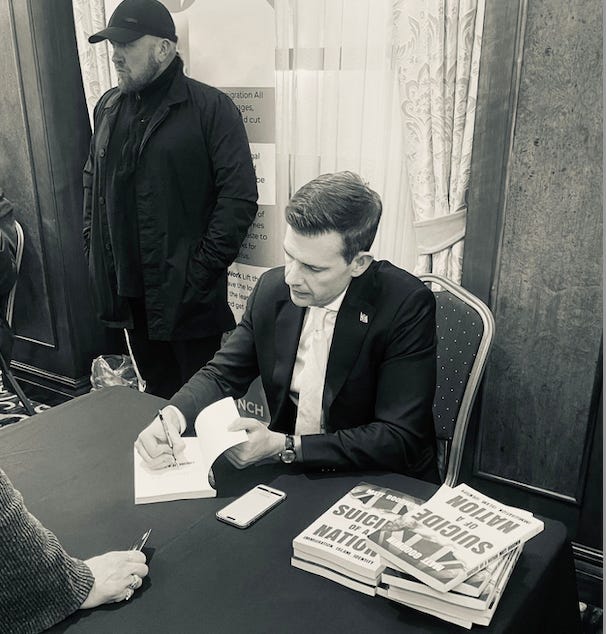
Something remarkable just happened.
According to The Bookseller - the leading magazine for the publishing industry - my new book Suicide of a Nation is now the Number 1 non-fiction paperback for small publishers and the Number 2 non-fiction paperback of ALL books in Britain.
Let that sink in.
Despite all the hate, the critics, the smears, the frenzied reaction to what I dared to write, Suicide of a Nation, is now one of the biggest books in Britain.
What makes this especially astonishing is that it’s also a book that was self-published - outside the traditional publishing system.
While I do not plan to keep writing about the book in this newsletter, given that we are still in the launch week I did want to address one question that I think is very important and has far-reaching implications for publishing, politics, and culture.
Why did I choose to self-publish my book in the first place?
The first and most obvious answer is because the mainstream publishers would simply never have published a book like this.
Let’s be completely honest about where we are in the West.
The vast majority of publishers today are not politically neutral institutions that are driven by the pursuit of truth, reason, and genuine creativity.
Far from it.
Like most other institutions that shape our cultural, intellectual, and political life, publishers now lean heavily, if not overwhelmingly, in one direction - towards a left-liberal worldview.
While they are obsessed with racial, sexual, and gender ‘diversity’, they actually operate in an ecosystem in which there is no genuine diversity of thought at all.
Just think.
When was the last time you saw a major publisher not only commission but seriously support - with energy, effort, and marketing - a book that deliberately ran against the left-liberal groupthink that dominates the institutions and our prevailing culture?
It simply doesn’t happen.
This groupthink has profound consequences.
It shapes which authors and which books get commissioned. It shapes which arguments are considered “acceptable”. And it determines which voices get amplified and which voices get quietly filtered out and, ultimately, shut down.
Publishers might push back against this by pointing to the one or two conservative or gender-critical writers they have had on their roster.
But the reality - as everybody in publishing knows - is that while these writers reflect views that are shared by roughly half the population (if not more), they are never given the same support as authors who do worship at the altar of left-progressivism.
And just look at the few occasions when genuinely counter-cultural writers have been recruited and supported. Routinely, the people who dared to write or publish these books with a mainstream publisher have been bullied, harassed, and intimidated.
Do I think Suicide of a Nation would have been commissioned, embraced, supported, and promoted by this mainstream publishing system? Of course not.
A book that openly challenges the prevailing liberal consensus on mass immigration, national identity, and multiculturalism was never going to glide effortlessly through the editorial meetings of London’s publishers.
In fact, I’ve seen what would have likely happened first-hand, based on my previous experience of working with mainstream publishers (this is my eighth book).
Let’s assume the book proposal would have been accepted and approved, which is a huge assumption given that most counter-cultural books are immediately filtered out.
The manuscript would then have been handed over to a junior editorial assistant who most likely just graduated from the woke dens of Oxford or Cambridge, and is fully indoctrinated (sorry, “immersed”) in the left-liberal groupthink.
The book would have been edited, censored, diluted, and reshaped beyond all recognition, whittled down to a pale or “safe” version of whatever it was before and a fundamentally different book from what the author had in mind.
It would then have gone through further “sensitivity” and “legal” checks, perhaps including another review by a senior editor, before being whittled down even further.
And then, with a final manuscript, the author would find themselves in a meeting with people from the marketing department, whose sole job it is to make sure that somebody out there actually reads the book.
But they too are dominated by left-leaning, twenty-something recent female graduates or middle-aged women who are instinctively hostile to anything that appears remotely “conservative”. Routinely, people’s ideological beliefs steer the conversation.
The success of your book, the manuscript that you nearly killed yourself writing for months and months, if not years, is now in the hands of people who clearly don’t like it, would rather not be working on it, and would probably prefer it didn’t exist at all.
All you will be left with is an overwhelming sense that while people might be going through the motions, your book - unlike others - is definitely not a priority.
And that’s precisely my point.
Having already written seven (much more tame) books - including two bestsellers - I knew that if I wanted then I could try and go through this tortuous process again.
But being in my forties, having gone through it multiple times, I knew that if you really wanted to take on the broken consensus then self-publishing was not just a fallback option. It was the only way to ensure this book existed at all.
It was also the only way I could regain control over the conversation, which is another reason why my critics hate Suicide of a Nation.
They cannot control the book - and they cannot control the conversations that the book is now sparking across the country.
In traditional publishing, like traditional media, there are layers upon layers of gatekeeping - editors, publicists, distributors, retailers, lawyers, sensitivity readers, and more - all of whom shape, soften, delay, and often quietly bury a book.
The shop that “doesn’t have it in stock”. The publicist that “couldn’t quite manage” to get it featured at the literary festivals. The sensitivity readers who conclude “readers might be triggered” by this or that paragraph. The lawyers who say “this is too risky - it’s not that we think something will happen but something might happen”.
This system is not just about quality control. It is about narrative control.
What the old gatekeepers want is to control what gets said, how it gets said, who says it, and whether it even gets said at all. It is all about control and censorship.
By self-publishing, I openly and deliberately stepped outside this system entirely.
No extensive editing. No ideological filters. No pressure to dilute or “reframe” the argument. No “triggering” paragraphs removed.
Just a direct line between myself and the reader.
Now, has this allowed one or two typos or historical misquotes to slip into the manuscript. Absolutely - and those are being fixed right now.
But the more important question is this:
Would I trade my freedom from this oppressive system of narrative control for a completely polished but also heavily edited and diluted manuscript? Not a chance. I will always choose freedom over control.
There are only 174 of 2,000 copies of the limited, personally signed Founder’s Edition left. Once they are gone they are gone. There will not be another print run. Get your copy here.
Which brings me to my final point: what this book and the publishing strategy behind it tell us about a more profound shift that is now taking place across the West.
The gatekeepers - the people who have spent the last half century or more controlling the narrative - are now losing their grip.
For decades, a small number of tightly-controlled and ideologically homogenous institutions - in publishing, media, academia, broadcasting - have shaped not only the national conversation but our entire national culture.
They set the tone, they defined the boundaries, they decided what was considered “serious” or “credible” and what was considered “unacceptable” or “beyond the pale”.
They anointed the authors, the “experts”, and the journalists who would become what they consider to be the arbiters of “truth” and “reason”.
They determined the parameters of what American writer Jonathan Rauch has called “the constitution of knowledge” - what is, or what is not, considered acceptable.
But that world is now fading.
And fading fast.
It’s not just reflected in the breakout success of self-published books like mine, which bypass the old gatekeepers, but can be seen elsewhere.
The rise of independent publishers. The rise of new television channels. The rise of Substacks. The rise of new voices that are openly cultivating new narratives that are attracting and mobilising mass audiences outside the old system.
The old gatekeepers, put simply, are no longer gatekeepers. Now, they are just one voice among many others - and often they are not even the loudest or most followed.
This is the new zeitgeist that I deliberately leaned into with this book - the rise of the outsiders, the anti-establishment writers and creators, the alternative perspectives, the people who are actually willing to represent what millions of ordinary people out there think and feel but who have been locked out of the system for decades.
Self-publishing Suicide of a Nation was not just a practical or even financial decision. It was strategic - it was about recognising where power in our society is moving and deliberately moving with it. It was completely consistent with my own belief in popular sovereignty - that power should reside with the people and it is the people who should be able to shape the direction of their own country and culture.
This is why despite the immense backlash, the coordinated attempt to discredit or cancel the book, the noise and smears, they have not been able to stop it.
Because they cannot stop it. I am in full control.
I do not need their approval. I do not crave their validation. I am not vulnerable to their pressure or criticism. I am not constrained by their networks. I do not need to worry about whether I will be allowed to write another book. I will not be pushed around by the academic and the expert class.
I am, in short, fully insulated.
Once you have a large and engaged audience, the whole dynamic changes.
I can take this book direct to the people. I can take it on the road. I can speak to audiences across the country. I can promote it. I can reach nearly 1 million people on social media. I can make this conversation happen - irrespective of what the old gatekeepers think. The old publishing model simply no longer makes sense.
And the result? We are competing — and winning — against books that are backed by the very institutions that were supposed to make self-publishing impossible.
What we have demonstrated is proof of concept.
So long as you are willing to take the heat, you can bypass the entire system, you can take and regain control, you can reach a mass audience, and you can succeed - commercially and culturally - on your own terms.
What I think this book shows, ultimately, is that the public is not as passive or easily managed as many people in publishing and media would like to believe.
People are looking for arguments that challenge the dreary consensus. They are looking for writers who tell it straight. And they are more than willing to step outside the mainstream to find it.
Nor are they idiots. They can recognise an attempted cancellation when they see it - and they are responding in numbers, by sending the book to the top of the charts.
That is the real story here.
Not just that Suicide of a Nation is climbing the charts. But that it is existing and thriving outside a system that would have stopped it from ever being written in the first place. And that, more than anything, is why I chose to self-publish.

The haters have turned out to be your best publicists ! Such an important book . Alison Pearson has mounted a sterling defence in the Telegraph today . Front page
Great book Matt. Ignore the haters! I do wonder though if Owen Jones will have such scrutiny with his new book?