

Does the Right in Britain need to unite? It’s one of the biggest questions in British politics right now — especially with rumours of an early general election once again swirling around Westminster. And it’s a question I address directly on today’s episode of The Silent Majority Podcast, in which I explain why the Left currently has a strong in-built advantage over the Right ahead of the next election.
If you want to support a platform that speaks up for the silent majority, challenges the establishment, and now reaches millions of people every month, then please join us as a paid supporter.
Paid supporters make everything we do possible — they can unlock every full episode of the podcast, every article, live discussions with me, our subscriber-only group chat, and the knowledge that you are helping us reach millions of people with arguments and evidence they simply won’t get anywhere else.
PODCAST TRANSCRIPT
Welcome to the Silent Majority Podcast with me, Matt Goodwin. My goal is simple, to tell you the truth, to bring you information you won’t get anywhere else, and to challenge an establishment that’s lost touch with millions of ordinary people. No groupthink, no political correctness, no forbidden questions.
Just the issues that really matter to you.
Come and join us at mattgoodwin.org.
Welcome everybody to the Silent Majority Podcast with me, Matt Goodwin. Now this is a podcast for people who are tired of being ignored, dismissed and shut out from our national conversation. Every Friday, I’m going to give you my unfiltered view of what is really happening in Britain and the West.
I’m going to bring you the evidence, the analysis, the statistics, the figures that you probably are not going to hear on the BBC. You’re probably not going to be able to get them anywhere else.
And I’m going to challenge the establishment. I’m going to challenge the establishment narratives that we are given from the BBC, from the institutions, from the dominant political class.
And I’m going to challenge The groupthink, the lazy groupthink that dominates our culture by asking questions that I think far too many people in politics and the media are too scared to ask or they don’t want to ask because of that lazy groupthink.
And today we’re starting with a big one, a really big question: Does the right in Britain need to unite? I’m going to show you some things you might not have seen before. I’m going to do this because I think it’s one of the most important questions of all going into the next general election in the United Kingdom, which I think millions of people can sense is going to be one of the most important general elections in our contemporary history.
But before we get to that, because this is our first episode, I just wanted to take a couple of minutes to to explain to you exactly why I decided to do this podcast and what I want it to become. Because I think today, if you look around the media landscape, if you look around the political debate, if you want to call it that, we already have countless podcasts.
And so many of those podcasts are made by the same kinds of people for the same kinds of people. They are podcasts that are created by people who have exactly the same underlying assumptions, who ask exactly the same questions, who reach exactly the same conclusions. Who often went to the very same schools and universities and who, to be frank, are completely disconnected from what millions of ordinary people out there in the country and indeed the West really think and believe.
So that’s why I wanted to try and do something a little bit different. I don’t want to have guests yelling at each other and talking over one another.
I don’t want to have any carefully We’re not going to rehearse talking points. We’re not going to cling to the establishment consensus. We’re not going to follow the lazy group think. I’m not going to tell you what you should think.
What I am going to do once a week, every Friday, is give you my unfiltered, honest view of of the biggest issues facing our country and Western nations. And I’m going to present to you and share to you evidence and information that you’re not going to get anywhere else and which I think will challenge the consensus.
So hopefully every week you learn something new.
Maybe you come across a study or some findings or some evidence that you’ve not really seen or heard anywhere else. I’m hopefully going to contribute to the conversation and I’m going to speak up and represent the silent majority, the millions of people out there who really feel as though their voice is not included in the conversation.
And I simply don’t think that ordinary people are being told about it. And that’s what I want to try and do with this podcast. That’s what the silent majority is really going to be about.
And I also want this to become more than a podcast. We have a community. Many of you, hopefully, who are listening to this are part of our community at mattgoodwin.org, a Substack community that began a few years ago and has now morphed into a place for nearly 100,000 people who check in every week to read books.
What we what I write, what I share on Mondays, Wednesdays and Fridays. So if you want to support our work, if you want to help us speak up for the forgotten majority, if you want to get everything that we’re producing, all of the articles, all of the commentary, if you want to come and join our subscriber group chat, if you want to meet me in live discussions, then please head over to mattgoodwin.org and become a paid supporter. Those are the people who make our work happen.
And just to give you some context, we are now reaching tens of millions of people every month through our social media and through our outreach. We’re one of the biggest Substacks in Europe, and it’s absolutely amazing. And it’s thanks to the support of our readers and subscribers that that has been made possible. And we’re actually getting the evidence and the arguments and the information out there.
And I think genuinely, we’re making a difference.
You can also, of course, put your questions directly to me, and you can join all of our private discussions. So that’s that. That’s why I decided to set up a podcast. That’s why I wanted to do something different.
What I want to ask is our first question, which is, does the right in Britain need to unite? Because what I want to show you today is actually what is going on in the United Kingdom. And one of the problems for people on the right, one of the problems for people who perhaps feel so frustrated with things like mass migration, broken borders, record taxes, record energy bills, woke ideology, political correctness, one of the big problems that I see is that the left, left wing parties have figured out how to win under our election system.
And people on the right are currently not doing what they need to do in order to win the next general election. And let me just say this at the outset that I believe firmly that we really only have maybe one election left to save Britain, to save the country.
Because of all of the things that are profoundly transforming Britain like other Western nations, mass uncontrolled immigration, which nobody ever voted for, broken borders, which nobody ever asked for, rapid and relentless demographic change, which, let’s be honest, is making many of our cities, our towns, our villages is leaving them completely unrecognisable.
Not to mention the way in which many of our taxpayer funded public institutions have moved sharply to the left. Over the last 10 or 20 years, while ordinary people have stayed exactly where they are, or if anything, they’ve moved a little bit to the right on issues around culture and identity. All of this has really left an enormous chasm at the heart of our politics. And it’s left many people desperately searching for an alternative.
And I think the next general election is going to be one of the big ones. It’s going to be a historic turning point, I think, in the history of the United Kingdom, one that will either push the country into more of this radical, if not extreme political and cultural change and essentially making that permanent.
Or it will see millions of people join together to say, no, actually we want to push the country in a completely different direction. We want to end the policies of mass uncontrolled immigration. We want to fix the borders. We want to embed a principle of national preference into the country.
We want to put the British people and British young people first. And we want to establish a country that gives power genuinely back to the people who have built that country, who make that country work and who want to pass that country on to their children and their grandchildren.
And I think many people can sense just how profound, fundamental and important the next general election is going to be, which is why, which is why if you look at the current polling and you look at what is happening in British politics today and you look at what would happen if there was a general election tomorrow, you can begin to see the problem that many of those people are going to encounter.
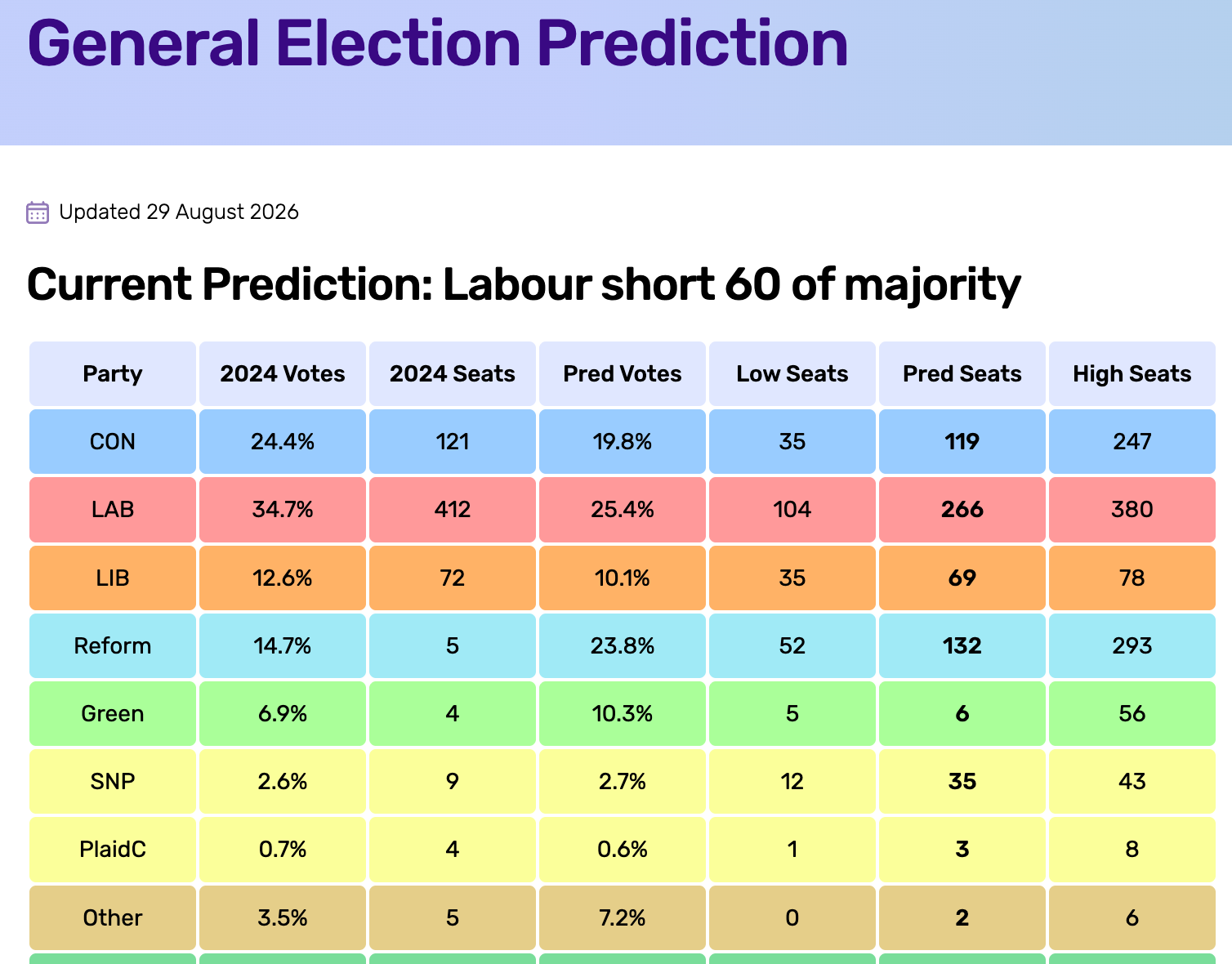
If you take all of the polling and I’m talking to you here in early September, 2026, if you take all of the polling and you run what’s called a forecast model and look at what would happen at the next general election.
And as of today, the result would be another five years of left wing, liberal left wing government. The Labour Party would fall 60 seats short of a majority, but would be able to cobble together a working majority with the Liberal Democrats. There would be a sort of Labour led coalition.
And the reason for that, for those of you who are watching this podcast and can see the numbers on the screen, the reason for that is because of the division on the right, because of the division between the Conservative Party, the Reform Party, and to a much lesser extent, Restore Britain.
If there were an election tomorrow, the Conservative Party are predicted to win 119 seats. Reform would replace the Conservative Party as the dominant party on the right of politics with 132 seats, obviously a very historic shift. Restore most likely would pick up perhaps one or two seats, maybe one in Great Yarmouth, and that’s about it.
But the key point here is that even though you see that significant takeover of the right by Nigel Farage and Reform UK, Nobody on the right actually enters power because they are well short of the 326 seats that you would need in order to win a majority and take control of the country.
Labour, the Liberal Democrats, the Greens, with over 50 seats, potentially, of course, alongside the SNP, would be able to cobble together some kind of working coalition. Now, this is the reality that is facing the right.
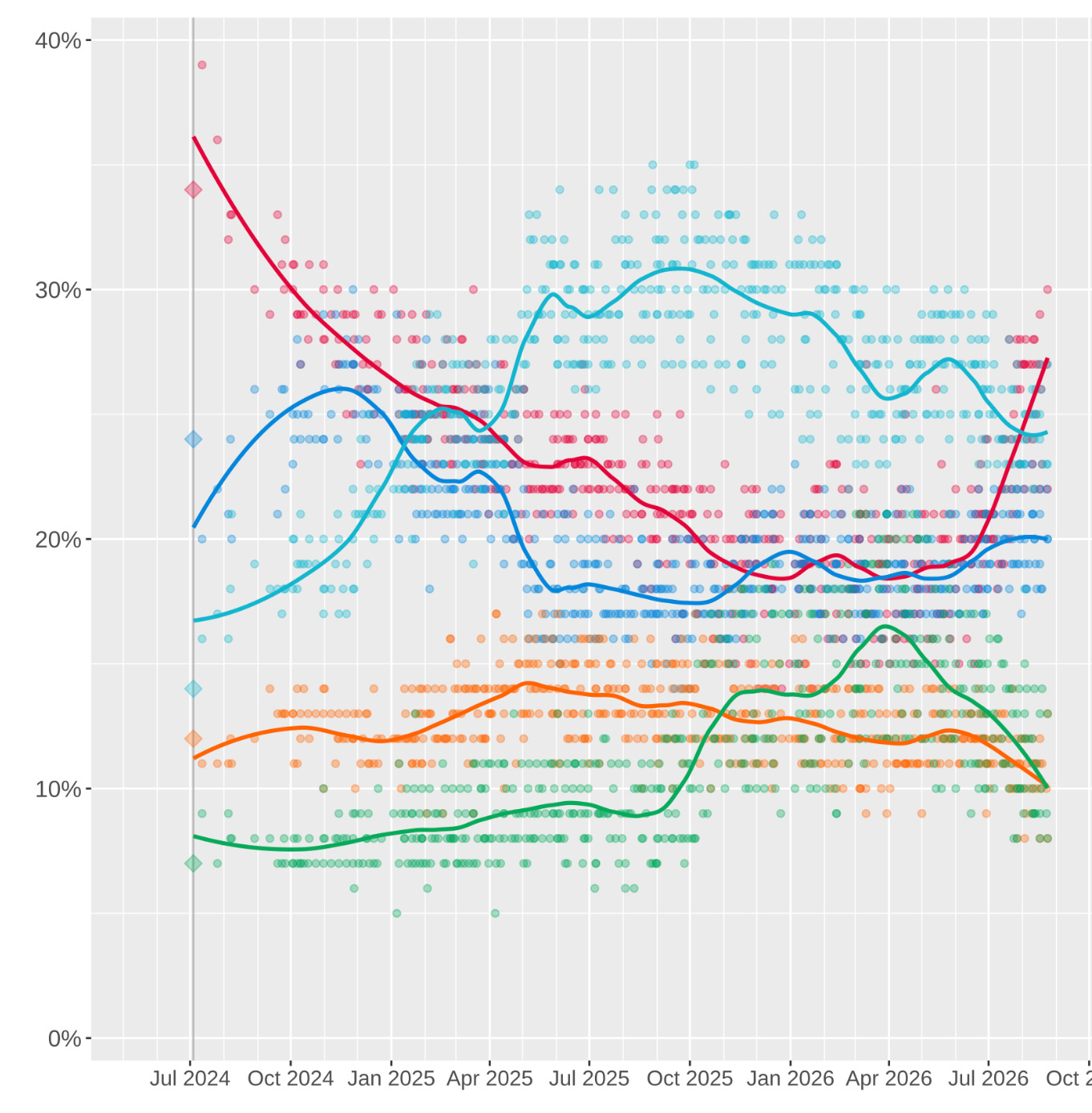
This is the reality that is facing the right in British politics. And the reason we’re seeing some of this is because the left is consolidating and the right remains divided. So what we’ve seen since Prime Minister Andy Burnham has come into office is he’s doing a better job at winning back people who have switched to the Greens.
He’s doing a better job at winning back some Liberal Democrats, and he is doing a better job at winning back People that voted Labour in 2024, but were then alienated by Keir Starmer’s premiership. So slowly but surely, this explains the bounce that the Labour Party have had in the polls. Andy Burnham has consolidated part of that left wing vote. But the right remains more divided than ever.
Now, I have a funny feeling. Prime Minister Andy Burnham is probably going to go for a general election earlier than many people think. And there are a few reasons why I think that’s going to happen.
One is he feels locked in by the 2024 mandate. He feels locked in by the manifesto that Labour campaigned on in 2024. He feels that he cannot get sufficient radicalism when it comes to economic and social policy. He won’t be able to move too far away from that manifesto. I think he’s also going to be looking at the debt markets, at the bond markets, and how they’re moving.
And what we can see currently is a great deal of concern in the financial markets about the direction of travel, rising costs, The cost of servicing Britain’s enormous pile of debt, we now have nearly three trillion pounds worth of debt.
The cost of servicing that debt is going up and up and a debt crisis, a big debt crisis of some kind looks likely. And it may be that some within the Labour Party want to potentially go to the country before that really does implode.
But the main reason Andy Burnham, I suspect, will go much earlier than people think will be because of this division on the right. And a strange place to start, but I think an important one is what happened at an obscure local election in Kent, Dover, Last week, where I just want to show you exactly what took place in the Guston Kingsdown and St Margaret’s at Cliff local by-election.
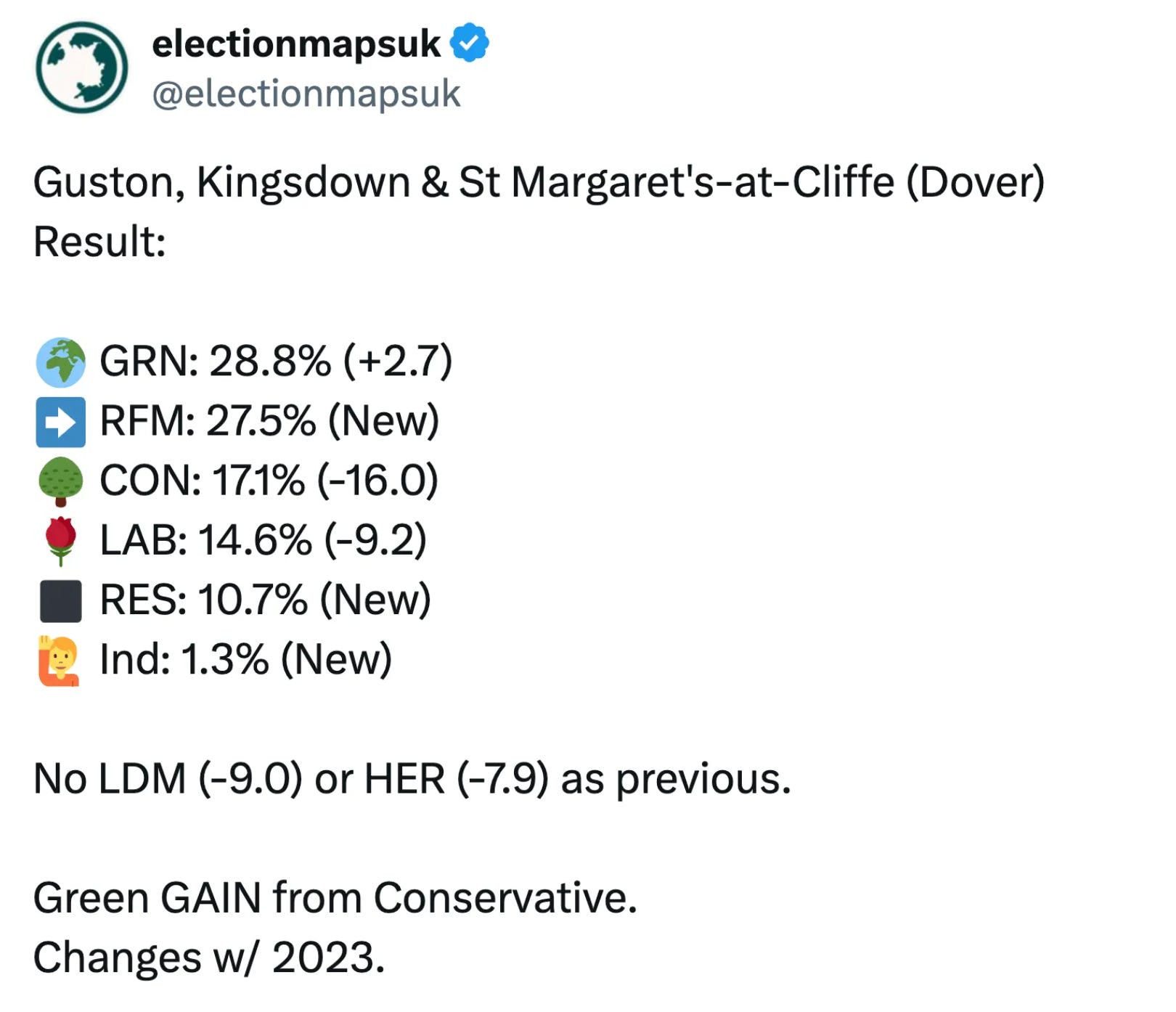
Not many people would have been watching it. But what was so fascinating about this contest is that parties on the right, between them, reform, the Tories, restore, polled 55% of the vote in this ward. More than half of all voters voted for the right.
And actually, you see this in many national polls. The right is polling upwards of 50%. So you can see the appetite is there for a change of direction in Britain and the country. But the Green Party ended up winning this local election on just 28% of the vote. In fact, it won the election by just 34 votes.
How is that possible, you might ask?
It’s possible because of how that right-wing vote was split three ways between reform, which emerged as a dominant party on the right with 27.5%, the Tories, 10 points behind on 17%, and Restore Britain, Rupert Lowe’s party, even further behind on 10%.
The reason I’m showing you this is because if the right do not get organised then this is exactly what is going to happen at the next general election in Britain. It might not be the Green Party winning, it will be Andy Burnham and the Labour Party.
Because under first-past-the-post, all you need to win a seat is not 50% and above. But in Britain’s election system, you just need one more vote than the second place party.
And so what you might see at the next general election is the result that we saw in Dover playing out from one seat to the next from one part of the country to the next as a divided right is outflanked by a more consolidated left.
Now, one of the reasons why people on the left really have an advantage at the moment over people on the right is because of what is actually going on underneath the surface, and that is tactical voting.
And I think this is going to be one of the big stories at the next general election in Britain, if I’m honest with you, because tactical voting is not impacting the left and the right equally. This is the big challenge that everybody on the right needs to think about and really needs to reflect on.
If you look at people on the left of British politics, Labour voters, Liberal Democrat voters, Green voters, they are much more likely to say they will vote tactically to stop the right than people on the right are in saying they would vote tactically to stop the left. Labour voters, for example, roughly 69-77% of Labour voters say they would switch to the Liberal Democrats to stop the Reform Party, or say they would switch to the Greens to stop the Tories and say they would switch to the Greens to stop Reform.
The overwhelming majority of Labour Party voters, in other words, would happily lend their vote to the Liberal Democrats or the Greens in order to stop the Right.
And if you’re watching this podcast, rather than listening, you’ll be able to see the numbers from a YouGov study just a few months ago that makes this crystal clear.
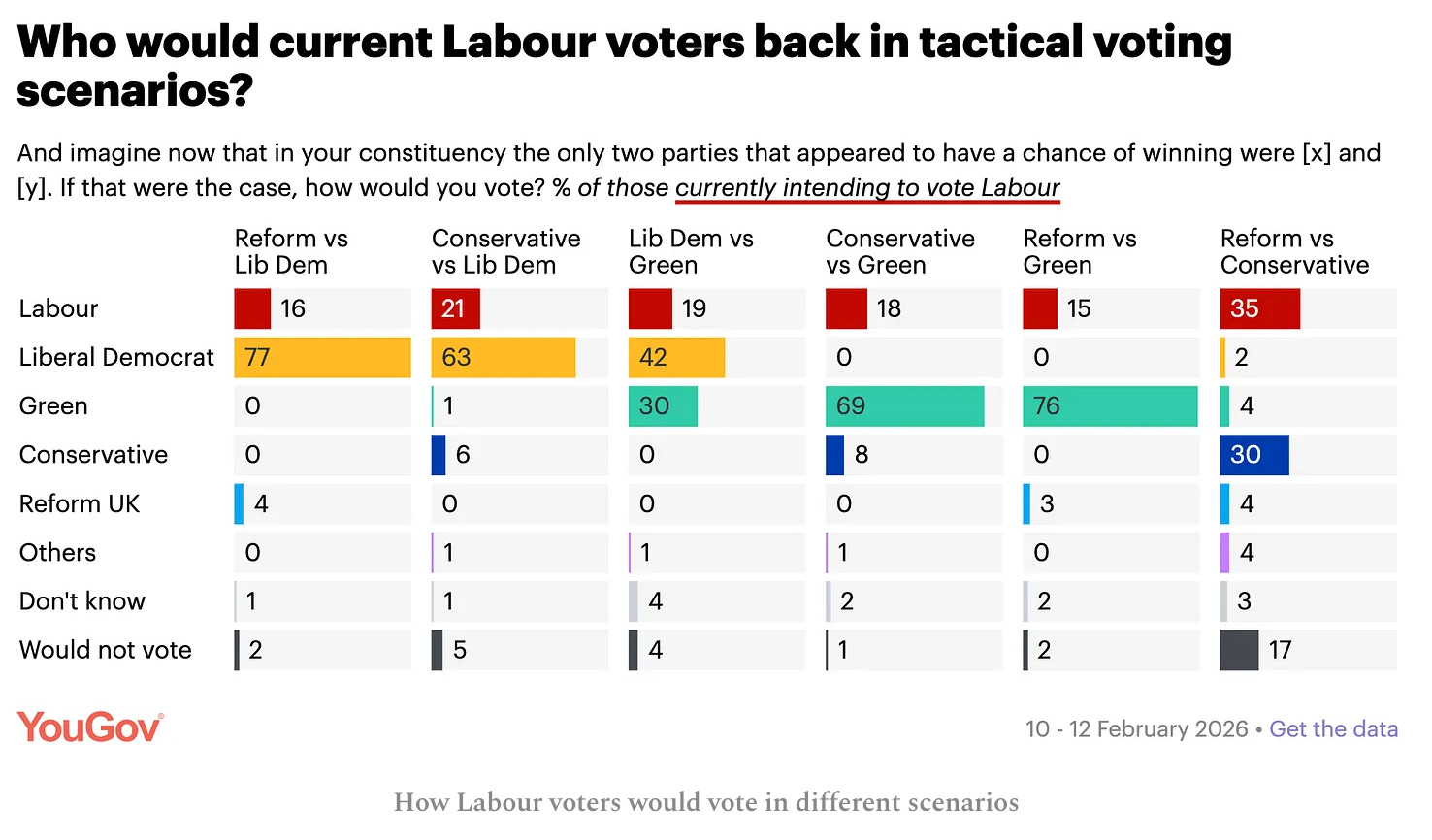
You have a much greater degree of discipline on the left when it comes to tactical voting than you have on the right.
Now let’s look at the right. Let’s look at how reform UK voters would vote under similar tactical voting scenarios. Well, imagine you were in a seat where it was Tory versus Lib Dem or Tory versus Labour or Tory versus Green.
In these scenarios, only between 37 and 41% of reform UK voters would switch to the Conservatives to help them get over the line. A much larger number would stay loyal to Reform UK. They are much less likely, Reform voters than their counterparts in the Labour Party or the Greens, to switch over and support another party tactically.
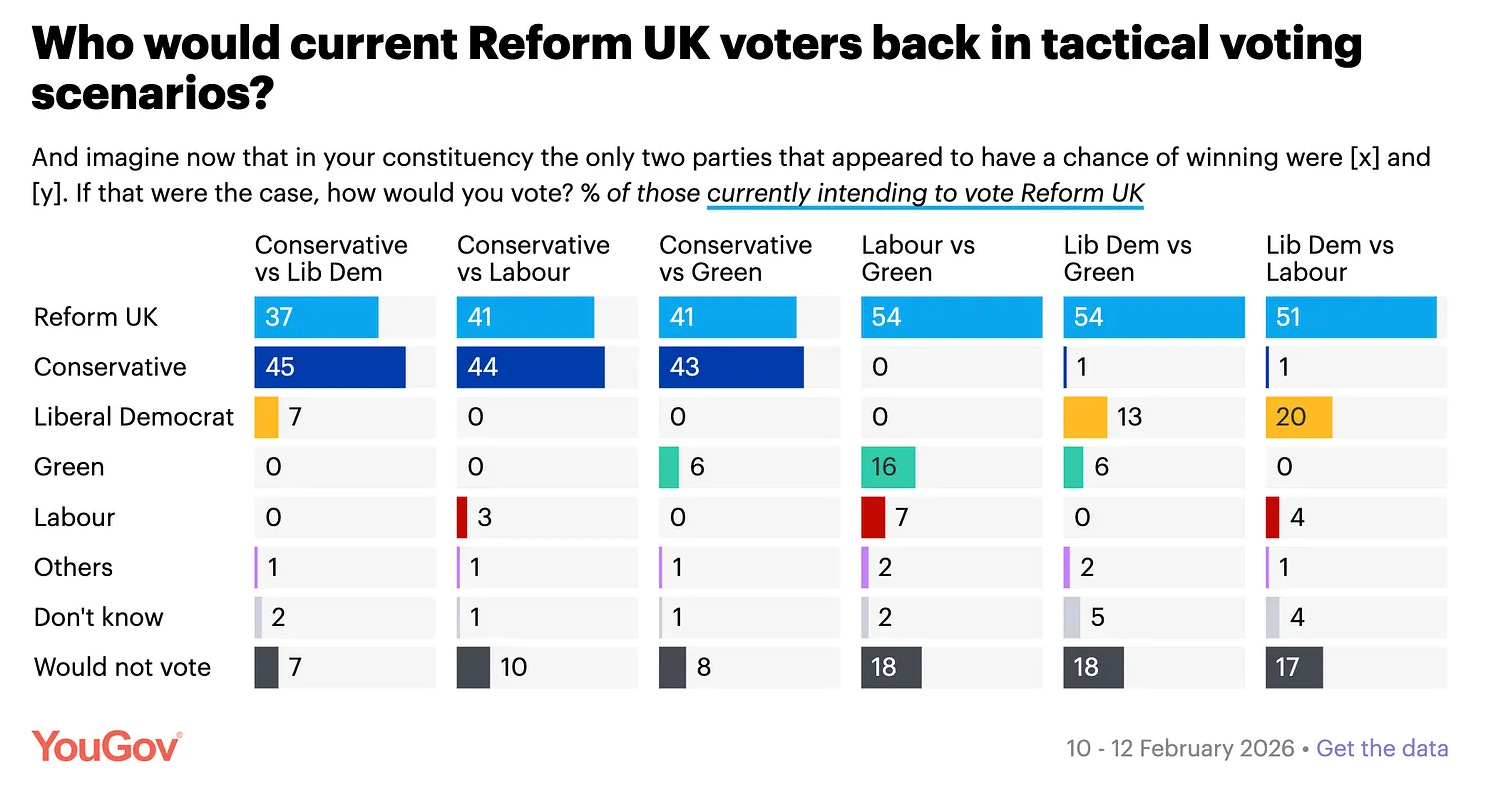
And you see exactly the same thing with Conservative voters. Conservative Party voters are much less likely than Labour, Lib Dem and Green voters to vote tactically.
This is what YouGov said when they were concluding that study. “Tactical voting among supporters of right-wing parties is both less common and less mutual, though it is still less present. The key line there being less common, less mutual.”
Now, how does Restore Britain fit into all of this? Well, it wasn’t included in that particular study, but there was another fascinating poll which asked Restore Britain voters whether they would be open to voting for Reform UK.
And only 36% of Restore Britain voters said they would be open to voting for Reform UK. 36%. And only 23% would be open to supporting the Conservatives. So again, what you see among Restore Britain voters, much lower numbers compared to those big 60-70% figures for Labour, Lib Dem and Green.
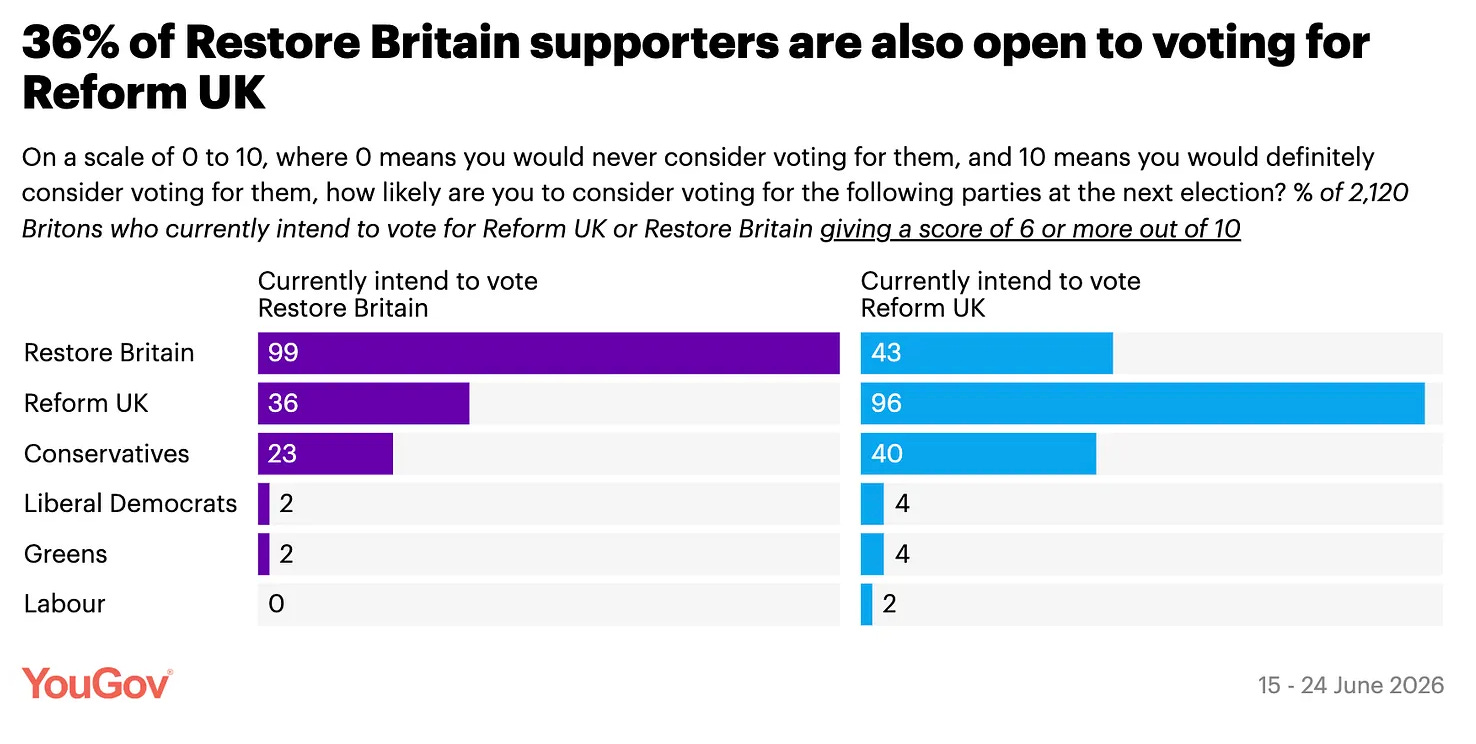
Restore voters are less willing to switch over to support reform UK at the next general election and to do so tactically. You might say to me, well, actually, Matt, maybe one tiny local council by-election in a corner of Kent is not going to predict what happens at the next general election.
But what I am saying to you is, it is a warning.
It is a warning of what is going to happen in this country, what is going to happen in If the right of politics does not actually get its act together.
If the right of British politics does not start to vote tactically, then it will lose the next general election. And then you need to think about what that means.
If the right in Britain loses the next election, it will be more mass uncontrolled immigration. It will be more broken borders. It will be more Woke ideology.
It will be more putting people ahead of the British people who are not even from Britain. It will be more of the sectarianism and the illegal family voting that we’re seeing across large parts of the country.
The kind of illegal family voting I warned about when I stood for Reform UK at the Gorton and Denton by-election and people said that I was a bad loser.
And yet two weeks ago, Birmingham City Council reveals that there had been election interference in 50 polling stations across our second city. And that comes after that study in Greater Manchester in the seat of Gorton and Denton, which found illegal family voting in more than two thirds of all polling stations.
This is what’s going to happen if the left win the next general election. More and more of our political system We’ll come under the influence of things like sectarianism, illegal family voting, and more and more of our cities, our towns and villages will become unrecognisable because of relentless demographic change.
The kind of change that Labor, the Liberal Democrats and the Greens are entirely comfortable with. So what I am saying, and let me be clear, what I’m saying to everybody on the right is this:
If you do not start to vote tactically, if you do not start to consolidate around one alternative to the establishment, then you will lose the next general election and the left will dominate Britain well into the 2030s.
I also would urge everybody to remember what happened in 2019. In 2019, When Boris Johnson promised to get Brexit done, Nigel Farage realised how close the country was to having that democratic vote for Brexit undermined and blocked by the establishment in Westminster.
And Nigel Farage decided on that basis to put the people and the country before his own interests by standing down candidates in hundreds of seats. Now, people at the time were unhappy with Nigel Farage for making that decision, but he put the country first. That allowed Boris Johnson to put together the realignment of British politics to outflank left-wing parties in large parts of the country.
Because Conservative voters, they are distributed more efficiently than left-wing voters. And it allowed Boris Johnson to win over Middle England. And what you saw was Labour, the Greens, Lib Dems and others piling up lots of boats in the cities, piling up lots of boats in the university towns, but they weren’t able to match the power of that people led realignment of the system.
Now, we know what happened next.
Boris Johnson and the Tories completely betrayed the people who had voted for them by presiding over the Boris wave, importing millions of people and basically nearly destroying our country. Only one in five of the people who came over under the Boris wave came on a worker visa, one in five.
Many of them brought 10, 11, 12 of their relatives. It was a complete betrayal of what the people asked for. But the realignment that made that election possible in 2019 remains very visible today. And that is why Reform UK have been able to power to the top of the opinion polls because they’ve started to lean into that realignment.
They’re now the most popular party among the working class, and the most popular party among Brexit voters. They’re also very, very popular among men. In some polls, they’re most popular party among men. And they’ve been putting back together that post-Brexit realignment.
My view, given some of the disagreements among individual politicians and leaders of political parties who are clearly struggling to find some kind of alliance, my view is that it would make much more sense to explain to voters, to have a conversation with voters, about the critical need to vote tactically at the next general election.
The people we might call the patriotic majority. That broad coalition is out there. Reform voters, Conservative voters, Restore Britain voters, and also millions of non-voters who don’t usually participate in general elections.
About two million non-voters came back into the political system to vote for Brexit, of course. That’s what made Brexit possible.
To say to all of those people, you have to now come together, consolidate, and support one clear alternative to the establishment. To the establishment that wants to continue with mass immigration, that wants to continue with open borders, that wants to continue putting people who are not from Britain ahead of the British people.
And that is the biggest task facing the right ahead of the next general election, because I do not believe that we can afford to lose that general election.
So the evidence is clear. The reason I suspect Andy Burnham will go for an early election is because of these divisions on the right.
And unless we’re able to get some unity among voters, to get that tactical voting among the supporters of reform, the Conservative Party and to a much lesser extent, restore Britain, which is really not very competitive outside of Great Yarmouth, then I fear the result will be the continued dominance of the left.
There are times in the history of a nation When you have to put the interests of that nation ahead of individual egos and individual political parties. And I genuinely believe the next general election is one of those times.
I want to thank you for listening to this week’s Silent Majority.
We’re putting out the early one or two episodes completely free on all platforms but soon free subscribers will only be able to access the first few minutes. If you’d like to join us in the future, come over to mattgoodwin.org. Join us as a subscriber. You’ll get not only all of the podcast episodes, but you’ll get all of our articles and no paywalls.
You’ll also be able to join our live discussions and you’ll be able to join our group chat. But for this week, that’s it for now. Have a think about what I said. Come and join us in the debates, in the chats, and I’ll see you there. Bye-bye.
Thank you for watching or listening to the Silent Majority podcast with me, Matt Goodwin, available on Spotify, Apple Podcasts and YouTube.


