

Join more than 90,000 readers and receive evidence and analysis that challenges the establishment each week. Become a paid supporter to unlock every article, the full Silent Majority podcast every Friday, and our group chat — while supporting independent voices that are speaking up for ordinary people.
Here’s something you might have missed.
With rumours of an early general election in the UK once again swirling around Westminster, most people have probably not even noticed what happened in a small corner of England this week.
It’s something that I think tells us a great deal about what might happen at the next general election and why people on the Right of politics should be deeply concerned.
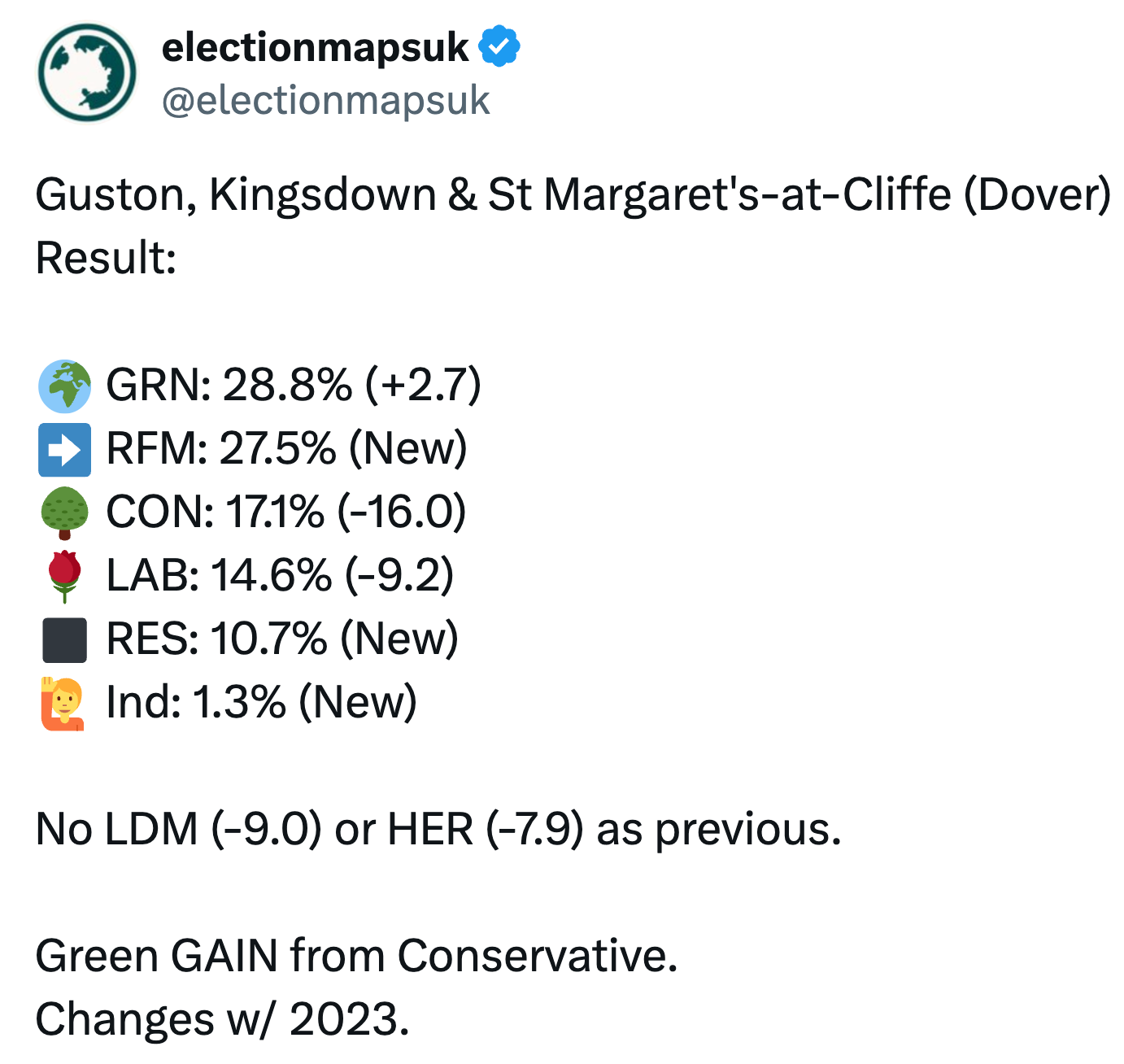
I’m referring to the result of a local by-election for the council seat of Guston, Kingsdown and St Margaret’s-at-Cliffe, located in the parliamentary constituency of Dover and Deal, in Kent, which is on the frontline of the small boat invasion.
Between them, three separate right-wing parties — Reform, the Tories, and Restore — polled 55 per cent of the vote, reflecting how this part of England remains incredibly receptive to ‘small c’ conservative politics.
But when all votes had been counted it was the Green party, on 28.7 per cent, which ended up winning by just 34 votes, allowing Zack Polanski and his increasingly extreme Green party to claim a small victory in the heartland of Brexit Country.
How were the Greens able to win?
Because while support for Left consolidated around the Greens — with support for Labour collapsing, the Liberal Democrats not fielding a candidate, and left-leaning people voting tactically — the Right was deeply divided.
Reform entrenched its status as the dominant right-wing party, taking 27.5 per cent. But the Tories also captured 17.1 per cent and Restore took another 10.7 per cent. While the Left benefitted from tactical voting, the Right split the vote three ways.
What this shows, I’ve warned before, is the real and growing danger that now faces a divided Right in British politics. And it’s precisely why I suspect Labour’s Andy Burnham is going to call a general election earlier than many people think.
Because while the Labour government is certainly pursuing disastrous policies, when it comes to electioneering they are not idiots. They can see the writing on the wall.
Britain has a first-post-the-post election system in which you do not win elections by assembling the largest ideological blocs but by finishing first in individual seats.
So, if Reform, the Tories, and Restore continue fighting for the same pool of voters, then the risk is obvious: what just happened in Dover will happen again and again, up and down the country, at the next general election.
Am I reading too much into one local by-election? Maybe.
But then again, maybe not.
Because a much bigger study of voters across Britain suggests the very same thing: there is likely to be widespread tactical voting at the next general election and it will not impact the Left and Right equally.
According to the study, by pollsters YouGov, people on the liberal left and the left-wing of British politics — Labour, Liberal Democrat, and Green party voters — are much more likely to say they will vote tactically across party lines than their Reform or Tory counterparts (the study did not include Restore).
And this tactical voting appears to be especially strong when the clear objective among left-wing voters is to try and stop Reform from winning seats.
Just look at some of the numbers because they really are important.
Close to 60 per cent of Liberal Democrat and Green party voters say they would vote tactically for Labour at the next general election to stop Reform winning a seat.
And between 63 and 77 per cent of Labour voters say they would likewise vote tactically for the Liberal Democrats or the Greens to prevent the Right from winning.
Confronted with a right-wing candidate in a seat where Labour is not competitive, large majorities of Labour voters say they would switch to the Lib Dems or the Greens to block the Right, while, astonishingly, close to one-third of Labour voters even say they would switch to the Tories in a two-way race between the Tories and Reform in order to stop Nigel Farage and his Reform party winning a seat.
What you see, in short, is a widespread willingness among voters on the Left to lend their vote to other socially liberal parties to try and stop the Right.
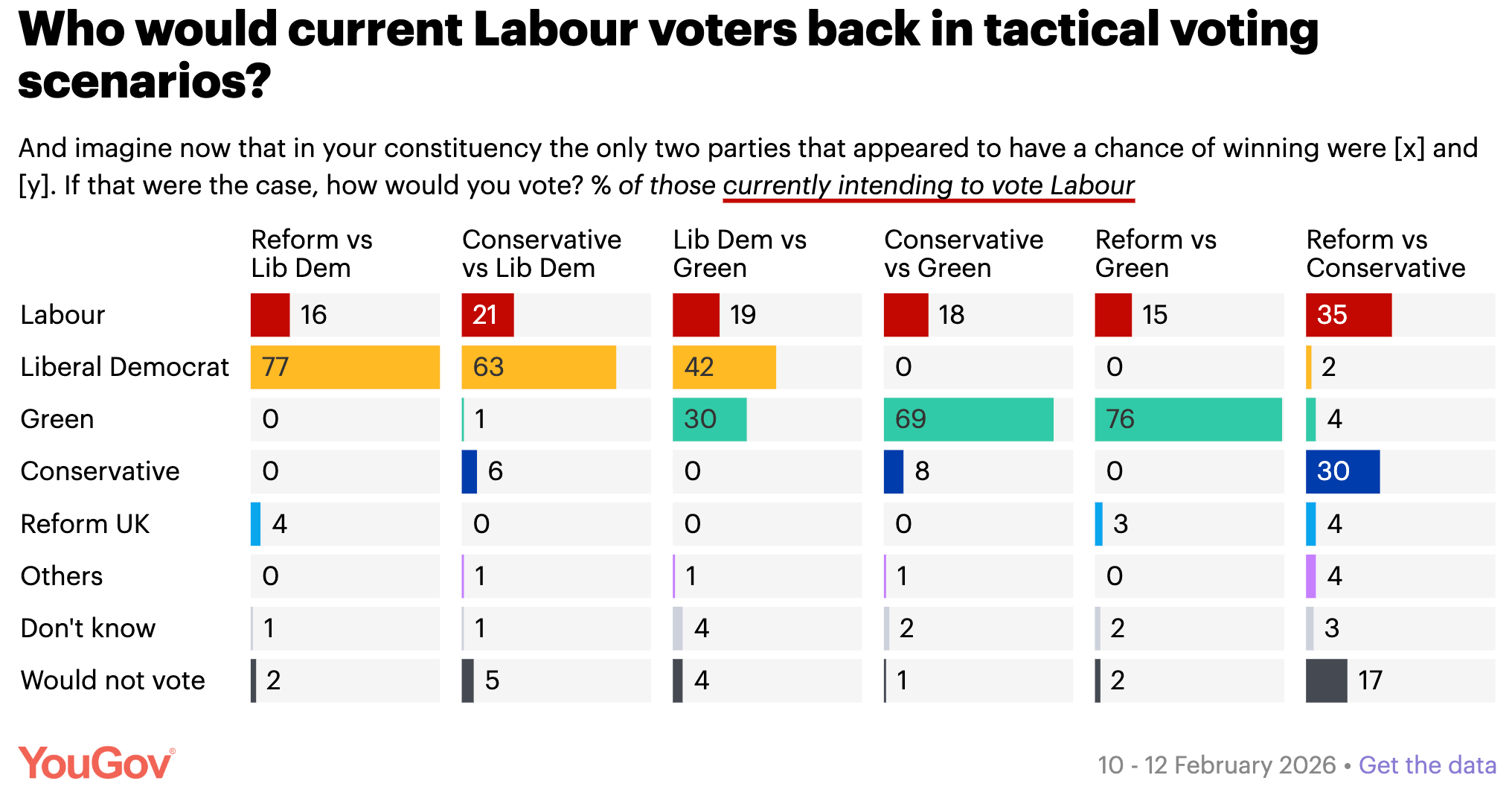
Large majorities of voters on the Left are clearly willing to cross party lines and switch their political loyalties if it means stopping Reform in its tracks.
But now look at the Right.
While large majorities of left-wing voters are prepared to vote tactically, only 43-45 per cent of Reform voters say they would similarly vote tactically for the Tories to fend off Labour, the Lib Dems, or the Greens. And even lower numbers of Tory voters, only 37-41 per cent of them, say they would vote tactically to stop the Left.
There is, put simply, more of a reluctance among voters on the Right than voters on the Left to vote tactically to achieve some kind of bigger objective at the next election.
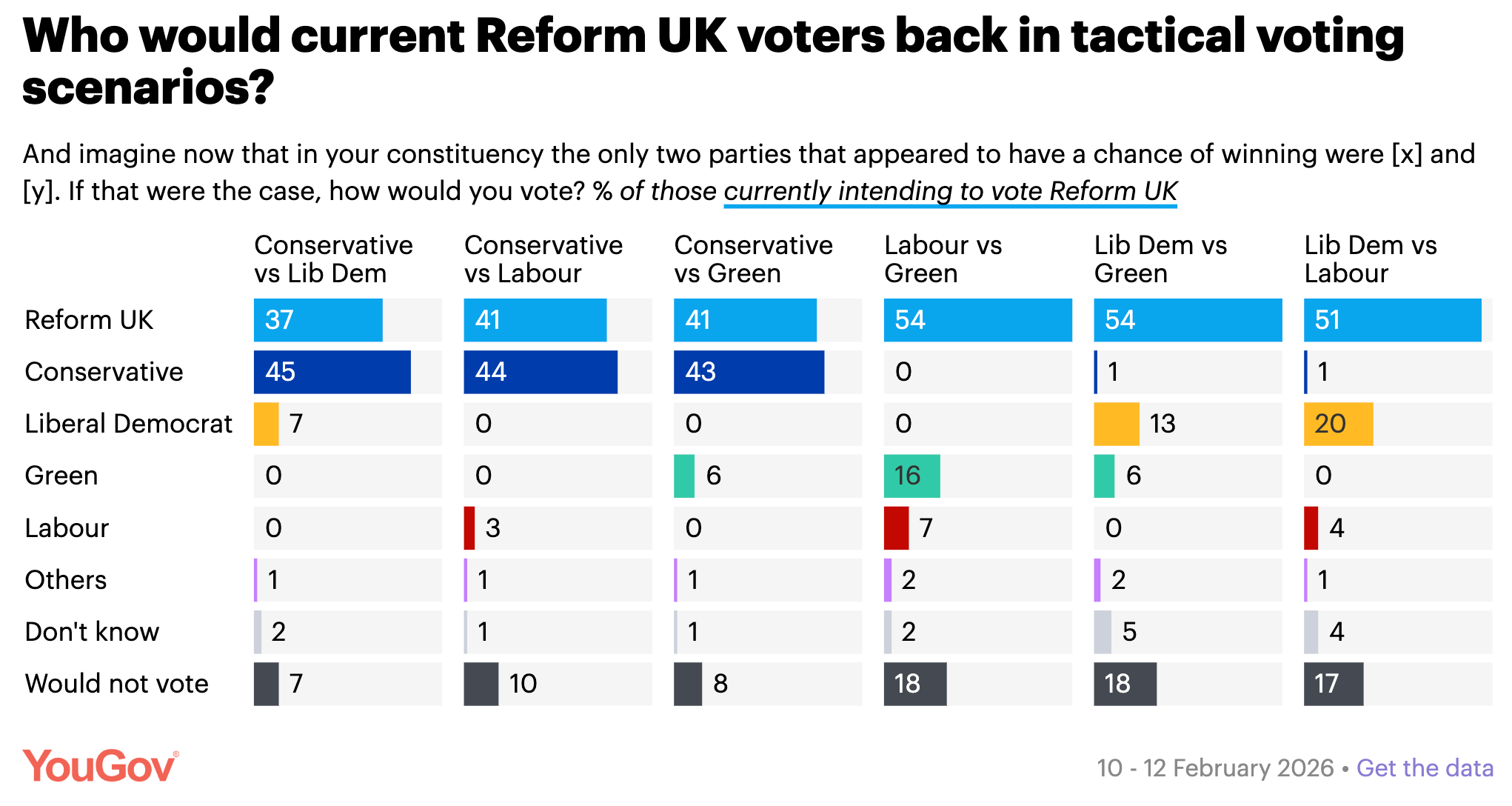
Imagine a two-horse race between Reform and Labour, for example. Only 41 per cent of Tory voters say they would switch to Reform to beat Labour.
Or imagine a two-horse race between Reform and the Greens — only 32 per cent of Tories say they would switch to Reform to stop Zack Polanski’s party while, astonishingly, close to one in five Tories would switch to the Greens to stop Reform.
Time and time again, when it comes to Tory and Reform voters, significant numbers say they would be unwilling to vote tactically for the other right-wing party.
“Tactical voting among supporters of right-wing parties”, note YouGov, in what is the key line in the study, “is both less common and less mutual, though it is still less present”. Less common. And less mutual. That’s the key point.
How does Restore fit into all this?