

Would you fight for Britain?
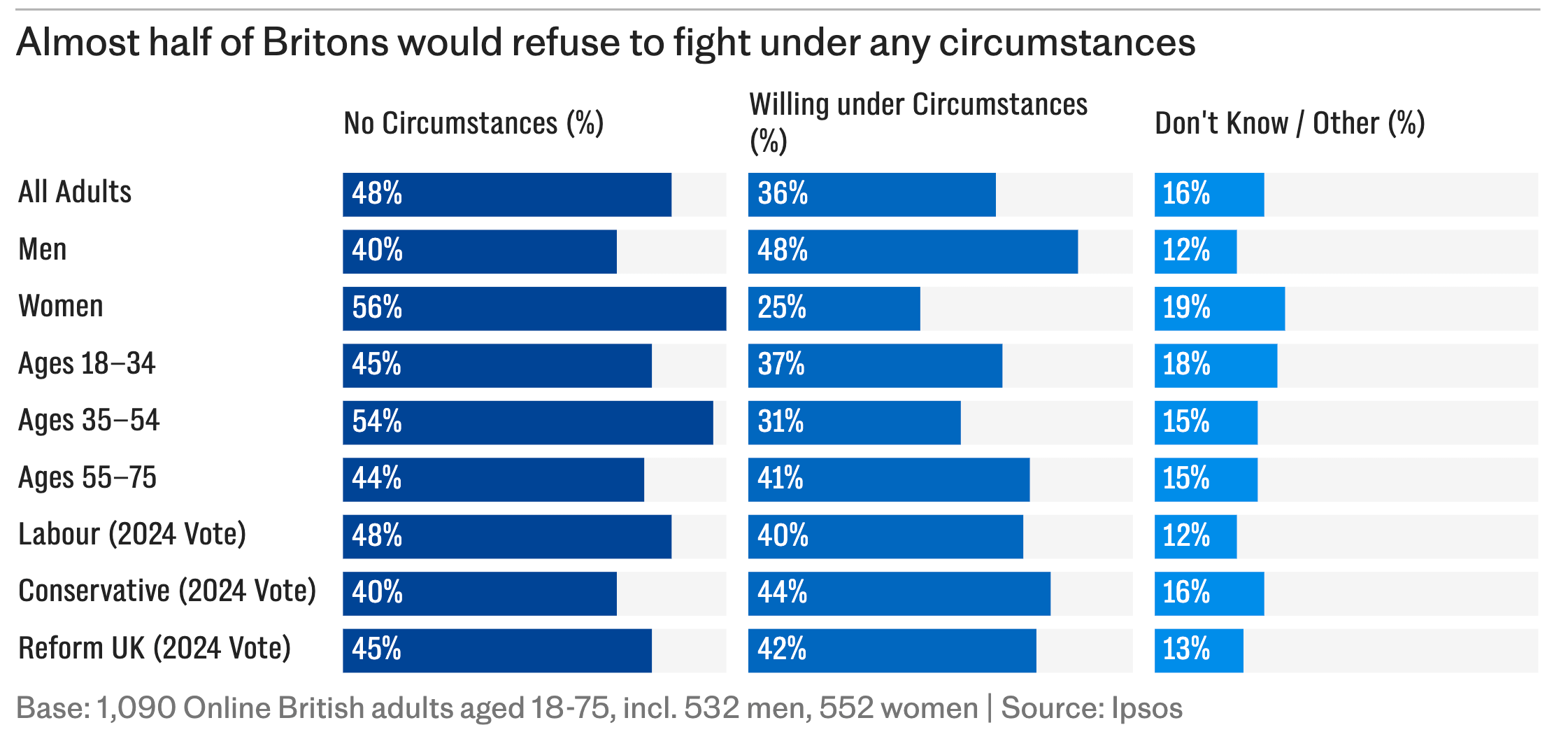
That was the question I debated on television earlier this week, after a poll found that close to 50 per cent of all British people — including nearly half of all young people — said there are ‘no circumstances’ in which they would fight for Britain.
I argued that we should not be surprised by these figures.
Because for years — as I wrote recently — our young people have been taught to hate their own country, see their history as a source of shame and embarrassment, and view their own British and English identity as things to be suspicious of.
Meanwhile, the Westminster politicians who now demand their loyalty and service have broken their side of the social contract.
How can they expect a generation of young British and English men to sacrifice for a country whose politicians allow ISIS terrorists to stream across our border, invest billions in overseas aid and welfare for foreign nationals, and do nothing as our young people struggle to get ahead or languish on benefits?
The clip, which you can watch below, clearly struck a nerve.
In only two days, it’s already been watched tens of millions of times, racking up enormous views on Facebook and more than 100,000 likes on Instagram, a social media platform that leans more strongly towards younger people.
But both the question and the debate also made me think about somebody else.
My grandfather.
At this time of year, as poppies gradually begin to appear, my mind inevitably drifts back to my grandad, “Pa”.
Every November, like clockwork, Pa would prepare to head down to the Cenotaph, on Whitehall, for Remembrance Sunday.
He followed a quiet routine but one that clearly held enormous significance.
He would polish his medals. Shine his shoes. Clean his best jacket. Then head into town to meet his “pals” — the men he had served alongside in the Second World War.
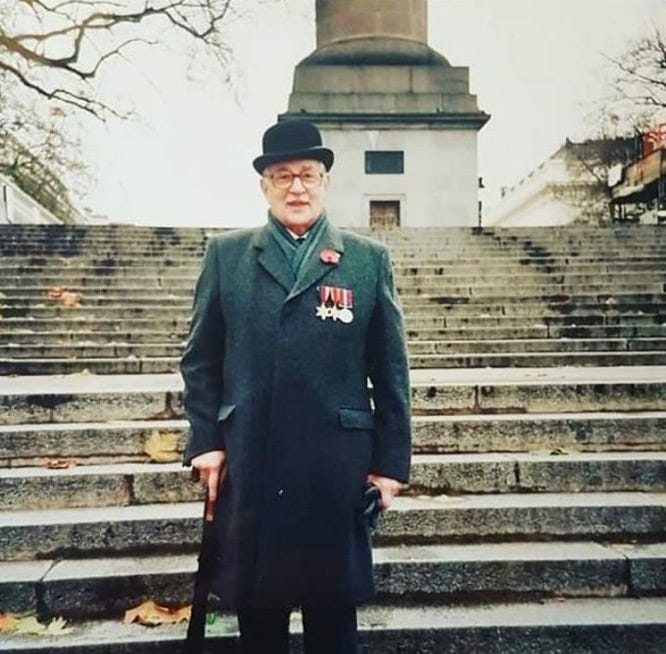
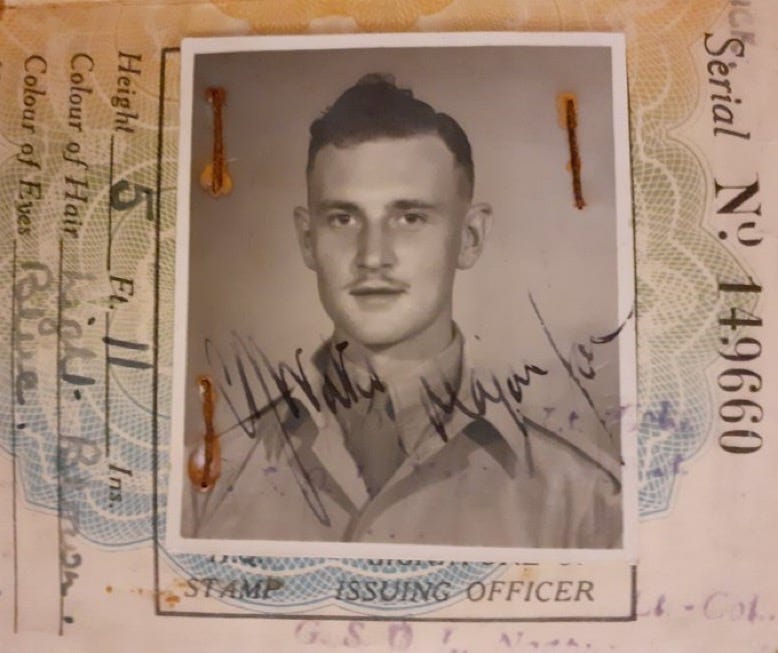
Pa served in the Chindits, the special forces that had operated deep behind enemy lines in the jungles of Burma. It was in many respects a Kamikaze mission.
If the notoriously brutal Japanese army didn’t get them then there was more than a good chance that flying into the jungles on fragile gliders that often fell apart mid-air, or malaria, dysentery, or simply starvation would.
Pa rarely spoke to us about what he had seen. Whenever my younger brother and I asked, he would be vague or change the conversation. Looking back now, as a father myself, I can see that he was trying to protect us.
One year, when I was perhaps eleven or twelve, Pa took me with him to the Cenotaph. I can still remember the bitter cold and my mother insisting that I wear a jacket, a tie and a poppy.
For hours, I stood alongside people I did not know. Yet I remember feeling that we shared something profoundly important: an unwritten bond that was simply there, holding us together. We were strangers, and yet we weren’t.
We watched the veterans pass the Cenotaph. And then, suddenly, I saw Pa.
Chest out. Looking straight ahead. His medals glinting in the winter sun. I still have an image in my mind of him spotting me in the crowd, looking at me out of the corner of his eye and giving me a wink.
I don’t know if that really happened or is a figment of my imagination. But what I do know — and can still remember — is that in that moment I was overwhelmed with a feeling that I had never really felt before as a young boy: immense pride.
All I knew in that moment, standing on the cold pavement on Whitehall, was that my grandad — like millions of other men whose relatives now stood alongside me — had done something incredibly important for our country.
After the service, Pa took me around the corner, onto the Embankment, to meet his pals. They laid a wreath at a memorial to the Chindits, which has their motto, which hints at what they went through, on the front: “The boldest measures are the safest”.
We stood there, again, in silence.
The old men saluted. Somebody played the Last Post. Curious tourists stopped to watch. And Pa just seemed to stared through the memorial, returning to a world that only those few men understood. I looked up at him, again, not yet realising that he would become my greatest role model.
Each year, their gathering became a little smaller. The number of pals a little lower.
When Pa died in 2010, one of his few remaining pals, now in a wheelchair, caught my eye at the funeral.
He slowly pulled himself out of the chair, placed an old, battered stereo on the table and asked everyone to be quiet.
After struggling to find the right button, he played the Last Post. Then he stood and saluted my grandfather, like they had saluted their pals every year at the Cenotaph.
I’ve never forgotten it. And I suspect I never will.
And that is why I find the question that we debated on television so troubling.
Because the bond that I felt during those moments, and the bond that had motivated Pa and his pals throughout their lives, was not an accident.
It had grown out of the things that hold nation-states together, inspire their citizens and hold them together over the longer-term — a shared sense of history, a collective memory, a shared national identity, a strong sense of belonging, and an understanding that we owe something to one another — and to those who came before us.
Yet for much of the last thirty or forty years, too many of our leaders by have been undermining these things.
They now teach our young people to see their own history, identity, and culture as a story of shame, oppression, colonialism, and regret — something I saw first hand while working in our country’s universities for twenty years.
The ‘decolonisation’ of reading lists so they become politically biased, anti-British and anti-Western.
The mainstreaming of ‘post-colonial’ and ‘critical race theories’ that portray the West as a site of racism and white privilege.
The increasingly strong left-wing slant in our schools, universities and many other institutions that celebrate every group and identity, except our own.
And the constant attacks on the symbols of our culture, history, and way of life that are not accidental but reflect a much broader assault on our country’s foundations.
At the same time, young British and English men look out at a political class that not only treats them like second-class citizens in the labour market and the education system but is unable to perform the most basic tasks of the state.
They cannot protect our borders. They refuse to prioritise our own people.
And they rarely if at all speak positively and confidently about the distinctive history, culture, and identity of our own country without reducing it to a celebration of other peoples and nations.
Look at the current debate over Englishness.
Why should young English men fight for England if all they hear is that flying the flag might put them in jail?
If all they are told is they must celebrate every other group and identity around the world — except the English?
If they watch the young English men who do try and protect our borders be thrown into jail or portrayed as extremists?
If they are constantly told Englishness is somehow suspicious, ‘racist’, or ‘far right’?
Or they are only allowed to talk about who they are if they forget there is anything distinctive or unique about them at all?
That being English or British today, our politicians claim, is now merely about the celebration of universal things such as ‘diversity’, football, fairness, or cricket?
Why would they fight for this?
Why should we expect young people to feel a strong sense of attachment and loyalty to their country when all they are told is that there is something wrong with coming from their country to begin with?
As Remembrance approaches, I will think again of Pa and his pals.
Of the men who stood silently at that memorial. Of the old soldier at his funeral, struggling with a battered stereo so that he could pay his final respects.
They remind me that Britain, that England, is about far more than the politicians who govern us.
It is the people, the memories, the loyalties and the unique cultural inheritance that bind us together in this place we call home.
That bond is incredibly precious.
So if the politicians in Westminster want our young people to go to war and risk their lives defending us they had better start giving them good reasons to understand this bond, cherish it and feel tied to it, too.
Because the people rooted in these islands, who built this country and made it their home, are so much more than our young people are being taught to believe.
Our paid supporters get everything — every single post, a reserved seat at our weekly discussion, full access to the archive, the group chat, the ability to leave comments and join the debate and, most importantly, the knowledge they are supporting a platform that is SPEAKING UP for the silent majority of people who want change. Your support helps us fund our team, expand our social media, and spread the word to millions of people.
Our biggest enemy, indeed the world's biggest enemy, has been invading the West for years, aided and abbetted by stunningly stupid politicians, like Theresa May, who signed the UN's (China's) 'Compact for Global Migration'. The idea that Russia is an enemy of the West is for low IQ fools. We don't need nuclear submarines, we need a large, domestic, patriotic army urgently.
Your moving recollections of your grandfather made me think of my own grandad....he died when I was a baby of lung cancer so I never got to know him. He'd enlisted in the Yorkshire Regiment in 1914, fought at the Somme and was also sent to Gallipoli where he was mustard gassed and sent home.... WW2 saw him working at the Royal SmallArms in Enfield - I never got to know him, but my grandmother explained the way things were during those dark days of war....surprisingly she said it was a time of people working together, helping each other, enjoying what they had, making do but treasuring each day.
As a society we no longer appear to have their strong character, ideologies, drive and sheer grit. We have allowed ourselves to become apathetic politically, willing to allow a ' trickle invasion' to change everything those previous generations willingly fought, and often died for, to keep safe and whole for us. We have let them down.... and we continue to let ourselves and our future generations down. We MUST change, and change soon.... or be lost forever as a country, as a culture, as a race.