

Matt Goodwin’s newsletter goes to 94,000 subscribers. Inner Circle and Paid subscribers access every post, the full archive, the comments, join Matt live every Friday, and know they’re supporting an independent writer speaking up for the silent majority. Join us on YouTube, Instagram, X and Facebook. We will always tell you truth. Support us by upgrading or donating.
Here is an entirely plausible scenario that could emerge after the next general election in the UK. Nigel Farage and Reform win a parliamentary majority. But upon entering office they soon find their plans for government are thwarted.
Rank-and-file civil servants go on strike. Senior civil servants publicly declare they are willing to help the new government while diluting and delaying its work behind the scenes. Countless civil servants leak embarrassing details and stories to their allies in legacy media. The machinery of government slows down, if not grinds to a halt.
Democratically-elected Reform MPs find they are unable to change anything. The people, exasperated with the paralysis in Westminster, turn away from not just Reform but democracy itself. Their one attempt to change the system, their one attempt to push Britain in a different direction, has failed.
Public support for Reform and public trust in the entire system collapse. What began as an energetic populist revolt is gradually but relentlessly worn down until it becomes lifeless, rudderless, incompetent, and remarkably unpopular.
This scenario, I suggest to you, is not just plausible – it is highly likely.
In fact, it is already underway.
Academic ‘experts’ on the civil service are already talking about the civil service engaging in ‘guerilla government’ against a democratically-elected government they do not like — such as by shirking, leaking, and whistleblowing.
Trade unions that represent civil servants are already openly debating going on strike if Reform does win the next general election.
The same state that did all it could to delay and dilute Brexit, in other words, will inevitably do all it can to try and undermine Reform’s populist insurgency, supported by its allies in legacy media and the university class.
Which is why something very important happened this week -- even though many people missed it. For the first time in British politics, an insurgent party that is on course to enter government acknowledged a crucial point: winning elections is no longer enough. Winning power through the ballot box is no longer enough.
In a striking new policy paper, titled ‘Fixing the Centre’, Reform UK makes it crystal clear that if the British people really want to take back control of their country and push it in a fundamentally different direction then they must not only win the next general election but confront what lies behind democratic politics.
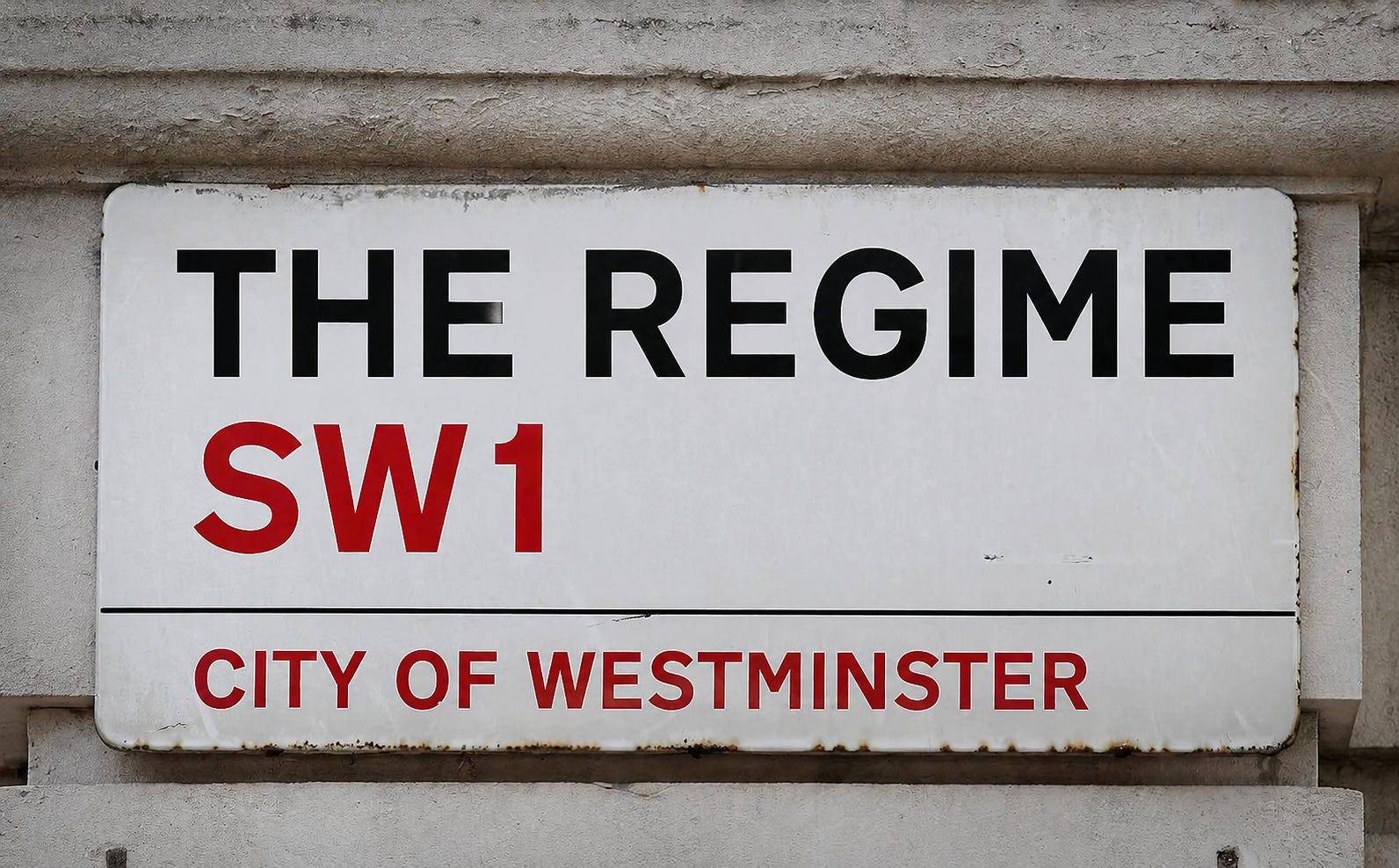
Whether we call it The Blob, The Establishment, The Managerial State, The Deep State, The State Bureaucracy, or - as I like to call it - The Regime, what we’re talking about is a deeply entrenched, highly coordinated, and permanent class of state administrators and bureaucrats who continue to govern the country irrespective of who wins power at democratic elections.
Just look at the UK.
In the last ten years alone, the state civil service ballooned from roughly 384,000 people to some 550,000. The share of senior civil servants who wield enormous influence over policy has rocketed from 60 to 75 per cent.
As Reform MP Danny Kruger points out, the Cabinet Office, which sits at the heart of government, now employs a staggering 11,000 staff. That’s more than twice the number in 2010 and one third of the size of the Royal Navy.
Today, furthermore, there are somewhere between 300 and 800 public bodies, or ‘Arm’s Length Public Bodies’, which employ roughly 400,000 full-time staff, and which, in turn, are surrounded by an entire industry of non-governmental organisations, charities, foundations, research councils, and lobbyists, none of which are democratically elected but all of which shape the general direction of travel.
Last year, one think-tank estimated there are now nearly 500 ‘quasi-non-governmental organisations’ operating in the UK that received nearly £400 billion in direct funding from the government and billions more from non-governmental sources.
Today, nearly one-third of all government spending lies beyond day-to-day control of government ministers and democratically-elected MPs. Just think about that.
And of the many thousands of people who staff The Regime and its various satellites – the civil service, the universities, charities, foundations, legacy media, and more – an estimated 75 per cent, according to one survey, identify with the political left.
As Danny Kruger wrote in The Times this week: “The fact is that real power is held not by the elected government but by the permanent civil service, especially the cabinet secretary and the sprawling, incoherent bureaucracy of the Cabinet Office.”
And while he did not say it, most of the people who operate this permanent state are politically opposed to what a large majority of voters in this country want to see. So, make no mistake: a political battle is most definitely coming.
Which is why the new plans, outlined by Reform UK, to fundamentally change the underlying machinery of government, are important. They want to radically overhaul the way government works.
By curbing the power of the Cabinet Office. By scrapping the role of Cabinet Secretary. By dramatically reforming the civil service, including by reducing its size and rewriting the Civil Service Code.
By giving government ministers the right and power to sack civil servants who block their democratically-elected agenda, perform poorly, or threaten to go on strike. By weakening the grip of civil servants and distant, unaccountable, unelected bodies.
By creating a much more powerful Office of the Prime Minister, surrounding the prime minister with strong and loyal political appointments who can not only ensure promises made to voters are delivered but that The Regime does not takeover.
And, ultimately, by restoring the influence of the people over a Regime that has now become fully insulated from democratic pressures. Because the blunt reality is that, today, across the West …
This post is one of our regular, weekly exclusive posts for our paid subscribers. Upgrade now to access every post, our live discussions with Matt every Friday, and support the silent majority. Pensioners, military veterans, and students can obtain a discount by emailing us direct.