

A quick note before we begin: as regular readers will have noticed, we’re now reserving more of our content for our paid subscribers who make our work possible. We now reach tens of millions of people every month through this newsletter and our social media. If you value our work, if you want to help our small team speak up for the silent majority, then please support us.
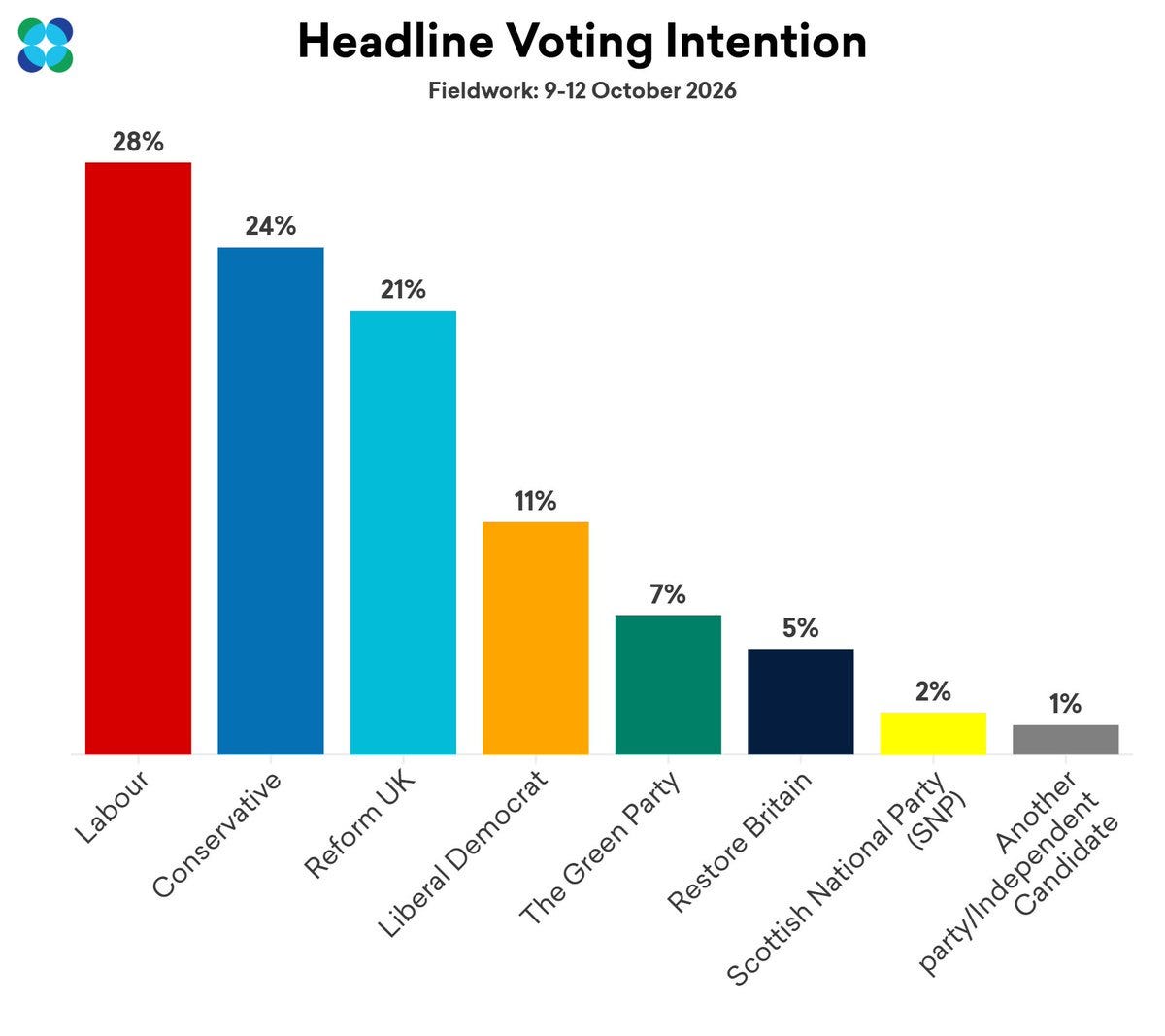
Well, it’s happened. Yesterday, for the first time since 2024, the Tories have moved ahead of Reform UK in a national poll.
The survey by YouGov puts Labour in the lead, on 24%, followed by the Tories on 23%, and then Reform in third place, on 21%. Is it a rogue poll? Today, another poll by More In Common found the same, also putting the Tories ahead of Reform.
Clearly, one or two polls do not establish a trend. But this does raise an important question. Why is Reform slipping in the polls?
For more than two years, one of the big stories in British politics has been Reform replacing the Tories as the dominant force on the right.
We tracked this process in detail. We were the first to see it coming. We undertook the most detailed studies of Reform party voters. And much of what has happened is what we predicted two years ago.
But now Reform’s advance has stalled. Over the last eighteen months, between Reform winning the local elections in May 2025 and today, the party’s average level of support in the polls has fallen from 30% to 23%.
The wider environment hasn’t really changed.
The British people haven’t stopped feeling concerned about immigration. They haven’t stopped worrying about the broken borders. They haven’t stopped struggling with the rising cost-of-living. They haven’t stopped feeling anxious about criminality. And they haven’t stopped distrusting the establishment.
If anything, public demand for an anti-establishment, anti-Westminster, anti-immigration party like Reform remains strong.
Just look across Europe. Similar parties are thriving. They are winning elections or on the verge of doing so.
But despite this favourable climate Reform has been slipping in the polls. I’ve looked at the latest polls and five key points stand out to me.
First, Reform is losing a significant number of its original supporters.
Last year, in May 2025, roughly 95% of the people who had voted for Nigel Farage and Reform UK at the most recent general election, in 2024, remained loyal to the party.
At least until the start of this year, they were fully committed.
They were enthusiastic. They were supportive of Reform. And they were fully on board with the mission to overturn the old parties in Westminster.
But then the zeal began to dwindle. This month, YouGov suggests that figure of 95% has fallen to 68%. This a major shift and the party needs to address it.
Second, there’s been significant fragmentation on the Right.
More than one-quarter of Reform’s original supporters have now defected to a rival right-wing party - albeit for differing reasons.
Last May, in 2025, just 3% of Reform’s voters had switched to the Tories. Today, 17% have. Nearly one in five people who voted Reform in 2024 have switched to the Tories.
At the same time, Reform has been weakened on another flank.
Roughly one in ten Reform voters, according to YouGov, have moved further right to Restore — a rival party that was established by former Reform MP Rupert Lowe.
When Restore voters were asked why they had switched to the party, they said (1) they think Restore is ‘the only party that is being honest about the issues facing Britain’, (2) they trust Restore to deal with the specific issue of immigration, (3) they personally like Rupert Lowe, and (4) ‘they are the only people to stand up for people like me’.
Another polling company, Opinium, has found much the same. Nearly one in ten of Reform’s original voters are now planning to vote for “some other party” and of these some 82% are planning to vote for Rupert Lowe and Restore Britain.
So, unlike eighteen months ago, Reform is now being squeezed on two flanks at the same time, which helps to explain why it’s declined in the national polls.
But these two flanks are not the same size. Far from it. Reform is currently losing …
… nearly twice as many of its 2024 voters to the Tory party as the number it’s losing to Restore. And this does point to future opportunities, however difficult things are now.
Looking ahead, the pool of potential support for Reform among Tory voters is roughly eleven times larger than it is among Restore.
If Reform won over every Restore voter — which is unlikely given that only 36% of Restore voters say they would vote tactically for Reform — it would gain 2-points.
If Reform won over just one in ten Tory voters it would add nearly 3-points. And if it won over one in five Tory voters it would add nearly 5-points.
This isn’t to say that appealing to Restore voters should not be a priority. Of course it should. It’s just to say there are many more votes for Reform to harvest by focusing on disillusioned Tories. Why are Tories not switching to Reform? I’ll come back to that.
Third, the coalition of voters that initially propelled Reform to the forefront of British politics — and which it needs if it is to become the largest right-wing party at the next general election — is now fracturing in significant ways.
Reform is not losing support evenly. Its decline is concentrated …