

Matt Goodwin’s newsletter goes to 94,000 subscribers. Inner Circle and Paid subscribers can access every post, the full archive, the comments, join Matt live every Friday, and know they are supporting an independent writer who speaks up for the silent majority. Join us on YouTube, Instagram, TikTok, X and Facebook. We will always tell you truth. Support us by upgrading or donating.
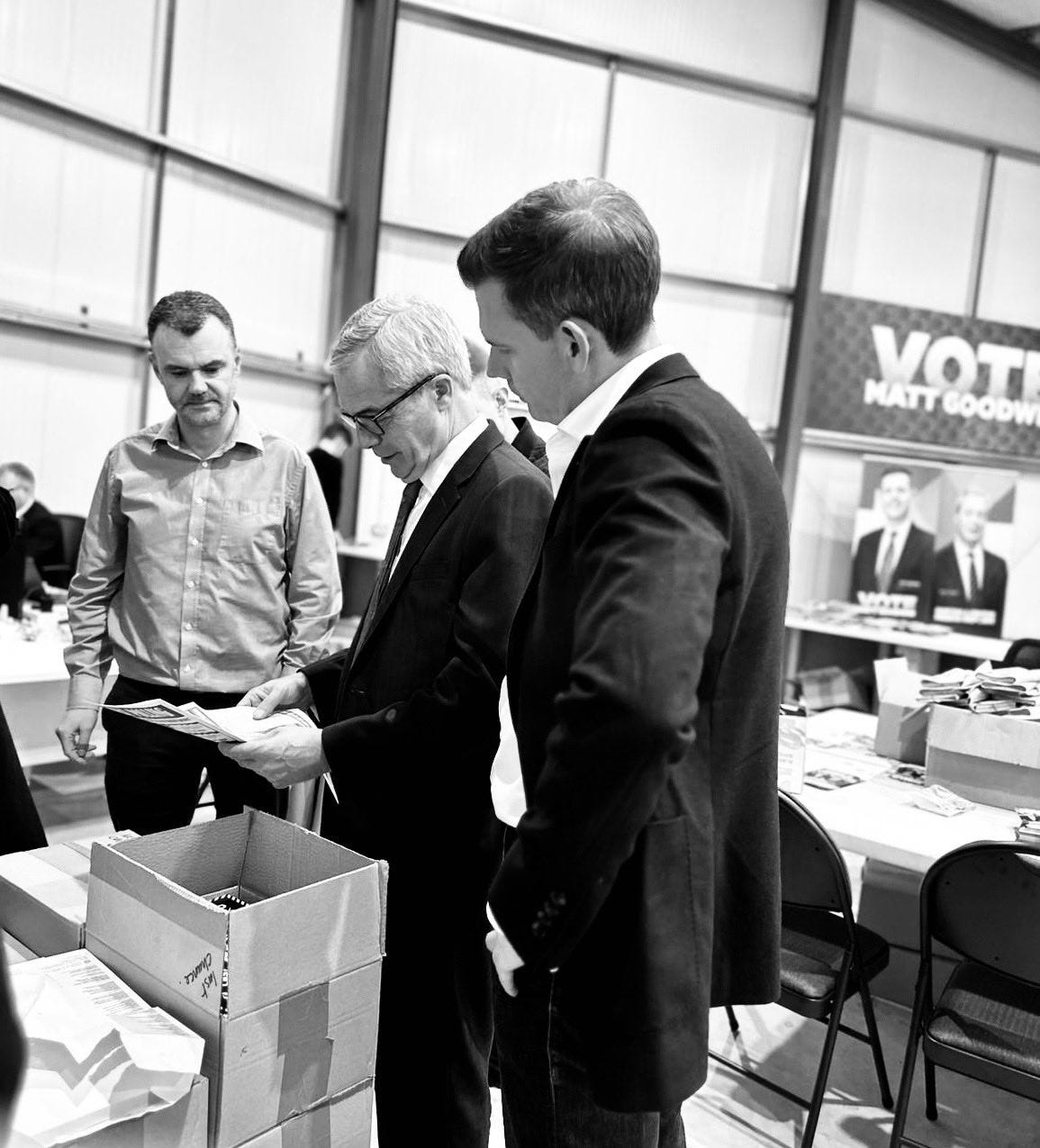
One of the strange things about fighting a by-election that is watched closely by much of the country is that it takes a bit of time to process what happened.
For weeks you are running on adrenaline.
Knocking doors. Speaking to voters. Responding to attacks. Managing volunteers. Tracking data. Sleeping less than you should. Trying to think three moves ahead.
And then it ends.
Only days later does the exhaustion settle in.
So, rather than rush to move on I decided to sit with it for a moment and do something constructive: write down what I think I learned from the experience.
So here, exclusively for our most committed supporters, before we get back to business as usual, are five things I learned from entering the political fray.
The first is that a small, disciplined team can achieve an extraordinary amount in a short space of time.
When we arrived in Gorton and Denton, we effectively had no meaningful data.
The seat had been leafleted before; but it had never been seriously canvassed.
There was no entrenched machine, no real data on how people were planning to vote (‘vote identification’, or VIs), no ‘pledge base’ (comprised of people who have committed to supporting you), and no ready-made ground operation.
Within four weeks that changed completely.
A core team of about ten people — backed by hundreds of Reform volunteers — collected voting intention data from roughly a third of the entire constituency.
Anybody who has ever run a campaign knows how impressive that is.
We built a pledge base of more than 13,000 identified Reform supporters.
We knocked on more than 300,000 doors, often returning to the same streets four or five times. We ran four canvassing sessions every single day.
That is not normal for a party in its infancy.
It reflects an ethos, a mood, that I referred to as “the Reform way”.
Knock more doors than anyone else. Collect more data than anyone else. Keep going until the final hour. No drift. No complacency. Just keep going.
Nigel Farage embodies that culture. He came to the seat repeatedly and canvassed without cameras or fanfare. So did Richard Tice, Sarah Pochin and Lee Anderson.
Yes, we finished in second place.
But embedding this activist culture matters more than most people realise. It’s how insurgent parties become serious contenders.
Polling close to 30 per cent in what is Reform’s 440th target seat is not an accident.
It is the product of this relentless ground work.
Had we had longer than four weeks — especially given that postal votes landed only two weeks into a very short campaign — then I suspect we would have narrowed the gap with the Greens even further.
Even in the final days we were still identifying 400-500 new pledges each day. That alone tells you something about where British politics is moving.
In the end, of course, things didn’t go our way.
But something inside Reform changed during this campaign.
And what I took away from it is the lesson that a small number of very committed people can make a huge difference in a short period of time.
The second lesson is that sometimes a gamble is worth it.
Let me explain what I mean.