

Matt Goodwin’s newsletter goes to 94,000 subscribers. Inner Circle and Paid subscribers can access every post, the full archive, the comments, join Matt live every Friday, and know they are supporting an independent writer who speaks up for the silent majority. Join us on YouTube, Instagram, TikTok, X and Facebook. We will always tell you truth. Support us by upgrading or donating.
Welcome to a new political year in Westminster, where the traditional political map continues to be blown apart. Just look at the latest poll, from YouGov.
Nigel Farage and Reform continue to lead, on 26%. Kemi Badenoch and the Tories are in a distant second, on just 19%. Keir Starmer and Labour have now slipped into third, on 17%. And Zack Polanski and the Greens are not far behind, on 15%.
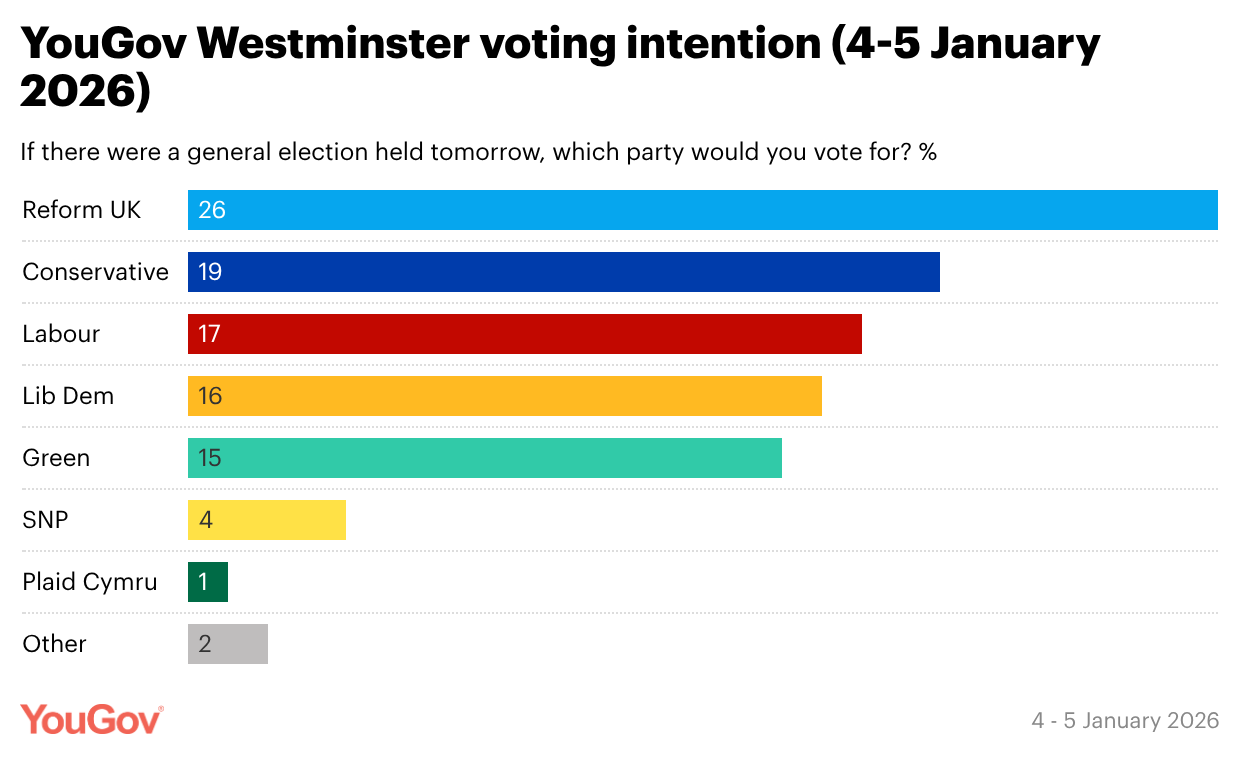
The real story here is a political system that is now rapidly fragmenting and polarising at the same time. Public support for the two old parties that have governed Britain for a century, Labour and the Tories, has slumped to just 36%, while nearly two-thirds of Brits are now supporting outsiders, protestors, or anti-establishment insurgents.
What’s going on? And where will this take us in 2026, and beyond?
The answer, I think, can be found in a new and fascinating academic study, which explains how and why the traditional grid of British politics is now being completely upended and replaced by something altogether different.
The traditional ‘left versus right’ battleground, in short, which kept Labour and the Tories alive and relevant, is now being replaced by the rise of two competing ‘blocks’ of party support which are significantly different from what has gone before.
This shift not only explains what is powering the likes of Nigel Farage and Zack Polanski but also points toward a very different political future for the country.
Let me explain, in detail, the findings of this study and why I think it really matters for what we are about to witness in 2026 and the next general election.
The story, in a way, begins with Brexit.
Ever since the 2016 referendum, Westminster has told the story of Brexit like it’s over — a closed chapter.
But a fascinating new study shows something else entirely:
The seismic shifts in the British people’s voting choices that Brexit brought about have not disappeared. They have just been redirected into something else.
The key conclusion? The issue that will continue reshape British politics in the next few years will not be Europe. It will be immigration.
Drawing on large-scale surveys of the British people, the study shows how, even before Brexit, British politics was already changing in profound ways.
People’s class background was already rapidly declining as the main driver of how they voted at elections. The old tribal allegiances that kept people tied to Labour or the Tories were already breaking down.
And British politics was already becoming far more ‘volatile’ —with record numbers of people switching their votes from one party to another.
Take a look at the charts below.
Since the 1960s, you can see how the number of people switching their support from one party to another, has surged to record numbers.
Combined support for the two old parties, Labour and Tories, also steadily collapsed. And the number of political parties that are competing for votes, reflecting the ‘fragmentation’ of the political system was steadily rising.
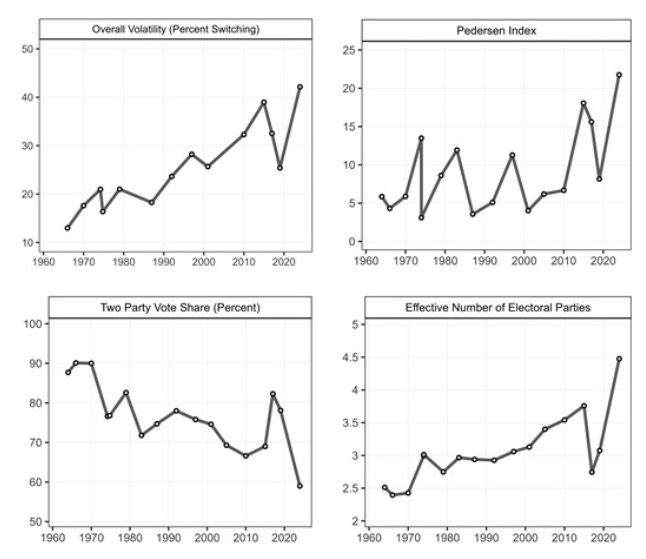
While the 2017 and 2019 elections, to some extent, disrupted these longer-term trends those trends are clear. Britain’s traditional two-party system was already coming apart.
Brexit then came along, super-charged all this and started to reshape British politics along entirely new lines — notably age, education, and people’s values.
People who are older, have not gone to university and hold more culturally conservative views backed Brexit, while those who are younger, have gone to university and hold more socially liberal views backed Remain.
Much of this is well-known.
Indeed, I tracked this ‘Brexit realignment’ myself, through several books and this newsletter, explaining why the national populist moment that arrived in 2016 was only going to intensify in the years ahead.
But what happened next?
This is where things get really interesting.