

Join our community of more than 90,000 people who speak up for the silent majority, challenge establishment narratives, and confront the biggest issues of our time with evidence, honesty, and debate. A small number of paid subscribers make our work possible. If you value our work, consider joining them. Paid subscribers meet on the Substack App every Monday evening at 8pm.
The first time I met Ann Widdecombe was actually rather terrifying.
It was at one of my first ever speaking events for Reform UK, in Kent, where Ann was speaking ahead of me.
If you were ever fortunate enough to see Ann speak live, then you’ll know how the sheer force of her oratory vastly exceeded her small frame. She was a powerhouse.
She used no notes. She pulled no punches. She was totally authentic. She spoke from the heart. She knew exactly what she believed—and why. She proceeded to tear the house down. It was a masterclass in how to rally a crowd.
As I stood at the back of the room watching this little old lady have complete command of the room, I remember thinking to myself:
“Crikey. How on earth am I supposed to follow that?”
The truth is, I couldn’t.
I was merely a former academic who had only just entered politics. I didn’t really understand the importance of simplicity, emotion, and being in tune with the crowd.
Ann, in sharp contrast, was a genuine political heavyweight who had spent decades refining her craft through public life. She knew precisely what to say, when to say it, and how to connect with an audience. Her timing was impeccable.
While Ann and I exchanged emails from time to time — particularly when she was considering starting her own Substack — the next time I saw her in person was only a few weeks before she was murdered, at another Reform event in Torquay.
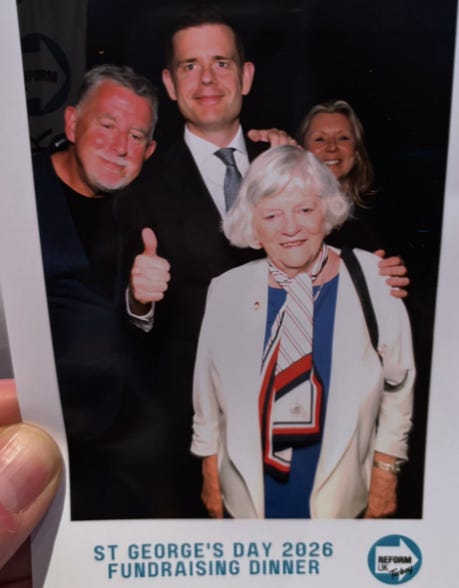
That evening we spent much of our time standing side by side, signing books and talking to people. Once again, when it came time to speak, Ann stole the show.
But what stayed with me wasn’t the speech. It was the way she treated people.
It didn’t matter whether somebody was a party activist, an MP, a branch organiser, a member of the hotel staff or simply somebody who had turned up out of curiosity.
If they wanted to speak with Ann, she gave them her full attention. She listened. She never appeared rushed. She always seemed interested. And she never made people feel they were an inconvenience.
I remember noticing that because, if I’m honest, it’s something I’m not naturally very good at. I’m usually rushing around, juggling too many things at once, thinking about the next interview or speech.
Looking back now, I specifically remember thinking on the way home that night: I should be more like Ann. A little kinder. A little more patient. A little more generous. A little more courteous.
Which is one reason why news of Ann’s murder hit me — and so many others inside Reform and across Westminster — so hard.
At first, like millions of others, I felt confused. I knew from the outset that what we were being told about Ann’s horrific murder was not right.
Nobody travels 300 miles to murder a well-known right-wing politician such as Ann unless it is premeditated and motivated in some way by political beliefs.
That’s just common sense. That’s just obvious.
And yet here were the police, in the immediate aftermath, not only claiming there was “no evidence” it was related to terrorism or politics, but displaying a complete lack of self-awareness by publicly praising their own police work.
How could they possibly know so soon? Why are they not simply saying: “it’s too early to know?” None of it made any sense to me — or millions of others.
And then, as I watched the reaction to Ann’s murder unfold across social media and Westminster, my confusion made way for an intense, unyielding anger.
Anger because of how an assortment of left-wing activists — Peter Tatchell, commentators on the BBC, and university staff — have such little class they decided to use the murder to make utterly horrific remarks about Ann and her legacy.
What we’ve seen, yet again, is an especially nasty and repulsive intolerance on the left of politics that simply has no equivalent on the right — the very same intolerance and hatred that we saw after the repeated attempts to assassinate President Trump and then the assassination of conservative activist Charlie Kirk.
Why is this concentrated on the left? Because as American academic Thomas Sowell pointed out, people on the left and right have completely different ‘moral visions’.
Whereas people on the right think people on the left are misguided, people on the left view people on the right as down right evil and so they will often celebrate violence against them, and think this violence can be justified (as the evidence clearly shows).
But I feel angry, too, because of how the instinctive reaction of the political class to Ann’s murder was not to question why the initial police response was so visibly dismal but, instead, berate the British people for daring to “speculate” about what might have happened.
Here’s an idea: if you don’t want people to “speculate”, then don’t try to gaslight them into thinking that somebody driving for three hours in a straight line from Rotherham to Devon to murder Ann Widdecombe has nothing to do with politics.
Only now, as evidence that the suspected murderer held communist literature and may have been linked to left-wing extremism has come to light, have the police finally changed their ridiculous tune, acknowledging that not only was Ann deliberately targeted but that she might have been part of a wider plot against Reform politicians.
In which case, why not just say at the very outset of the investigation: “We don’t know what caused this - we do not know if this was connected to politics”?
Because what we see during awful moments like this one is a much deeper problem in British society, which is the steady collapse of public confidence and trust in the police and indeed the entire criminal justice system. And much of this decline of trust in the institutions, I think, is entirely justified.
If you don’t want people to openly question what they are being told by the police and the establishment then don’t continuously gaslight and mislead the country in the aftermath of major atrocities and murders like this one.
If you don’t want people speculating or questioning the official narrative, then stop treating the aftermath of every atrocity as some kind of PR-exercise, trying to make us believe, for instance, that somebody such as Axel Rudakubana was “a nice British choir boy from Cardiff”, endlessly delaying the details of crimes when they happen to involve illegal migrants or people from minority backgrounds, or telling us to hold hands and sing songs, praise diversity, and do anything except look at the actual cause of major atrocities and terrorist attacks.
If you don’t want people questioning the state then stop using shadowy government units to subject them to ‘psy-ops’, using mainstream media to deflect our attention from the real issue. Focusing on the families of victims that, strangely, always seem to make statements in support of immigration and diversity while selectively ignoring other families – such as Rhiannon Whyte’s family – who challenge the narrative by calling on government to stop the illegal migration that killed their daughter.
If you want us to trust the political class and the institutions then don’t tell us that it’s fine for left-wing politicians to attack and vilify ‘the right’ after the murder of Labour politicians like Jo Cox, but then accuse Nigel Farage, leader of Reform, who simply wants truth and justice for Ann, of trying to “politicise” the tragedy.
Don’t allow the death of somebody in America such as George Floyd to be exploited and used to justify a full-scale cultural revolution against the West, but then accuse Reform politicians who are merely asking questions about what happened to their friend and colleague of “exploiting” the situation.
And while we’re here, don’t corrupt our police organisations and criminal justice system with the extreme, divisive, and unBritish ideology of Critical Race Theory, which deliberately pits different racial and ethnic groups against one another, and then claim there is “no such thing” as politically-biased, two-tier policing.
If you don’t want the people to “speculate” and ask questions, in other words, then I would suggest that the state urgently finds new ways of restoring public confidence and trust in police and the criminal justice system before things really get out of hand.
Which means? Rooting out two-tier policing. Rooting out diversity, equality, and inclusion policies. Stopping the endless psy-ops and social engineering tactics that are deliberately designed to gaslight and mislead people in the name of promoting “social cohesion”, or “community relations”.
Telling people the truth about what is really going on, which means if you don’t know what is behind a crime then just say “we don’t know right now”. Just be real with us. Be honest. Be open. Be direct. Be transparent. Talk about the actual cause, what actually happened. Just stop the endless gaslighting and obfuscation.
And, most important of all, get back to what used to guide this country before it was hijacked by an utterly divisive identity politics — equality before the law. Treat people equally before the law — irrespective of their race, ethnicity, or religion.
Do some of that and you may well find that the next time a tragedy like this unfolds – which ended in the brutal murder of our friend Ann – the British people might be less willing to “speculate” about what happened, may be more trusting of the police, and feel a lot less suspicious of the official narratives than they currently do.
The Ann Widdecombe I knew would never have wanted people to have been frightened or lectured into silence, or told not to ask difficult questions.
She believed politics required courage, honesty, clarity, free speech, and good faith debate. Those qualities are also the only way our institutions will rebuild the public trust they have now spent many years losing.
Until that happens, people will continue to ask questions — not because they enjoy speculation, but because they no longer believe they are being told the whole truth.
And until people start to see changes they have every right to feel this way.
Well said Matt. RIP Ann Widdicombe. A truly honest, conviction politician. One of very few in general but a total rarity on the left. As for the police- I despair.
There is far more intolerance on the left of politics than the right but maybe it’s time we fought that narrative. It’s born of decades of leftie indoctrination stemming from the Fabian Society. Years of the left claiming the moral high ground, sneering and abusing anyone with a different opinion has left people on the right squirming and on the defensive. Isn’t it time for the right to fight back positively with evidence of the good that has been done for society and that there’s nothing good about putting the entire world before your own people. It’s time the right were loud and proud. And in terms of the next election - our last hope, we need to give people hope and a positive reason for voting.
Oh, and have a nice "right-wing extremist threat to Muslim event" story up your sleeve to deploy at about the same time as announcing the left-wing extremist aspect to Miss Widdecombe's murder.