

Join Britain's fastest-growing independent political community which provides more than 90,000 readers with counter-cultural evidence, analysis, and debate that challenges the establishment. Our work is funded by our readers. Become a paid subscriber to unlock every single article, join our live weekly discussions with Matt, our group chat, leave comments, and know you’re helping the silent majority.
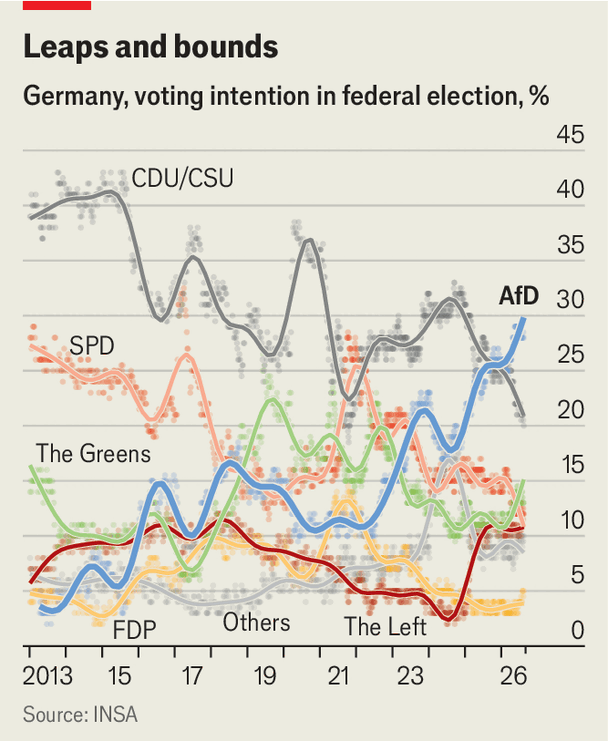
Something truly extraordinary is about to take place in Germany. And if you want to make sense of the sheer scale and strength of the populist rebellion that’s unfolding against the established political class in the West then you cannot ignore it.
In just a few weeks, the people of Saxony-Anhalt, in the eastern half of the country, go to the polls in a crunch state election. Then, two weeks later, the people of Mecklenburg-Vorpommern, in the north-east, do the same. And if the polls are right Germany is about to experience the biggest political earthquake in recent history.
Why? Because in Saxony-Anhalt the national-populist Alternative for Germany, the AfD, a party that openly rejects mass immigration, open borders, and political correctness, is polling at an astonishing 42% of the vote.
An anti-establishment, anti-immigration party that is widely loathed by the political class is polling roughly 20-points ahead of its nearest competitor, the centre-right Christian Democrats (CDU), which has controlled this state for nearly 25 years. The left, as you can see in the chart below, is simply nowhere to be seen:
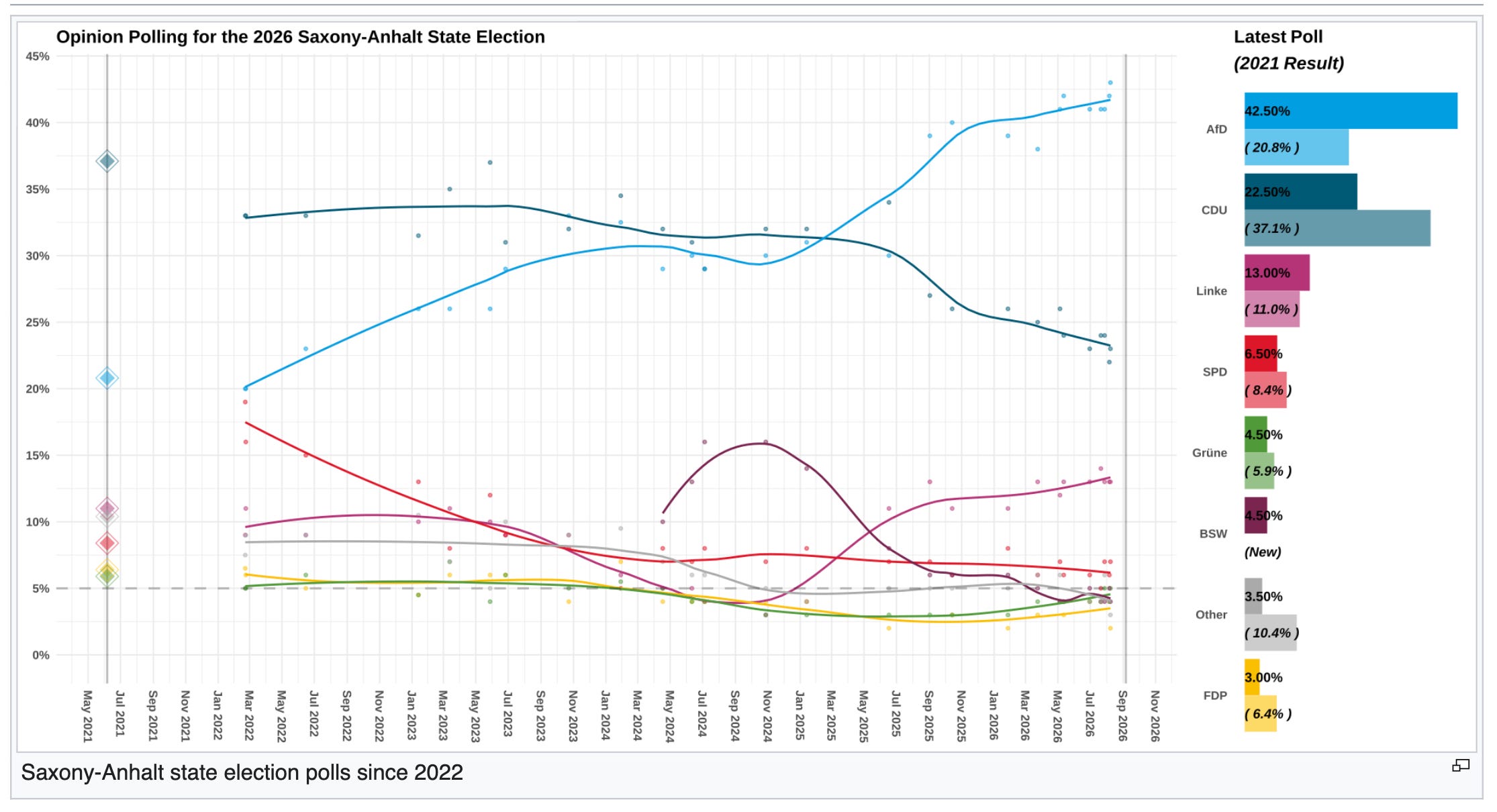
These shifts are seismic. At the last election in this state, only five years ago, the Alternative for Germany finished in a very distant second, on 21%. But now, on September 6th, a party that is calling for the ‘remigration’ of migrants back to their countries of origin, is on course to potentially double its vote in just five years.
And that’s not all. A few weeks later, on September 20th, another election will be held in Mecklenburg-Vorpommern where, again, the AfD is leading in the polls.
In this state, which has been held by the centre-left Social Democrats for nearly thirty years, the polls put the AfD on roughly 36%, some 7-points clear of the left.
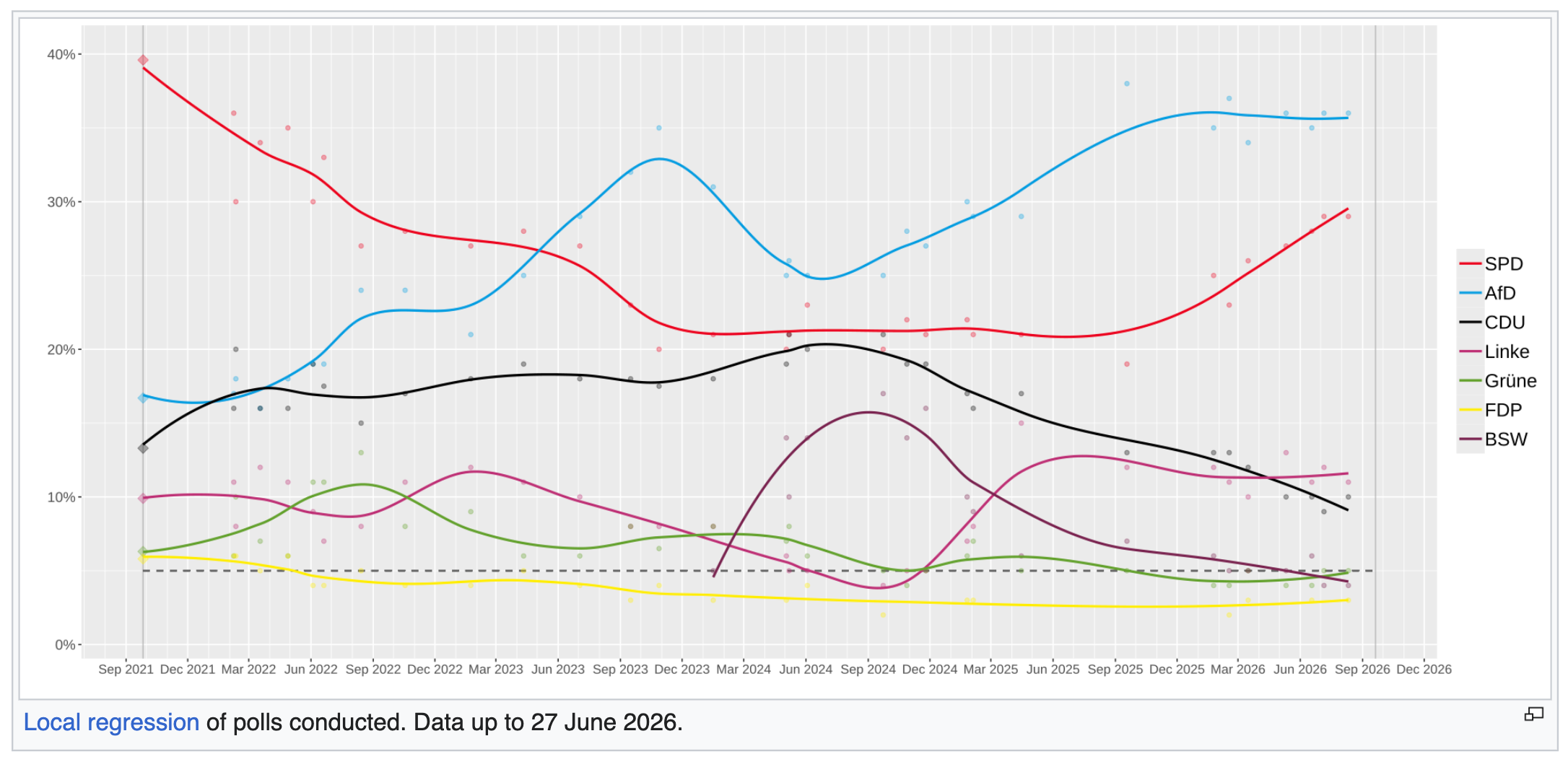
Again, what we are witnessing — if it comes to pass on polling day — is truly historic.
The last time an election was held in this state the Alternative for Germany finished a distant second on just 16% of the vote. Now, unless the polls have got something badly wrong, the party looks set to more than double its support.
Germany has never seen anything like this.
Since the Alternative for Germany was created, in 2013, the party has never governed a state. But if the AfD takes power next month then we would see the first ever AfD-led state government in the history of the Federal Republic. This would not only send major shockwaves through Germany but much of Europe.
It would instantly smash the so-called ‘firewall’ that Germany’s establishment has tried to maintain against allowing the AfD into government.
A firewall is only possible when insurgent parties are on around 5 or 10% of the vote. But when they are polling between 35 and 46% of the vote, when they are attracting millions of ordinary Germans who are fed-up with mass immigration, demographic change, broken borders, and economic decline, then firewalls become impossible.
A breakthrough of this magnitude for the AfD would also do something else.
It would make it crystal clear to the established political class in not just Germany but across Europe that the national-populist rebellion, which has been brewing for thirty years, is not only here to stay but — as we predicted — soaring to new heights.
If you had suggested even decade ago, nevermind twenty or thirty years ago, that a radical right party in Germany would be polling these kinds of numbers, and would be on the cusp of becoming the largest party in key German states, then most political analysts and commentators would have laughed you out of the room.
But here we are.
And while many analysts will try to convince you the AfD’s rise is really just a story about the more economically deprived and left behind eastern half of Germany, this is deeply misleading.
While the AfD is certainly stronger in the east, earlier this year the party won close to 20% in the wealthier, southwestern state of Baden-Württemberg, more than doubling its vote and moving from fifth to third. In another southwestern state, Rhineland-Palatinate, the AfD likewise more than doubled its support.
Even in more liberal Berlin, where there is also a state election next month, the polls suggest the AfD is on course to double its support, while in Germany’s national polls the party that was once dismissed as one for cranks, racists, and right-wing extremists is now pulling away from the established centre-right in first place, pointing to an even bigger political earthquake on the horizon.
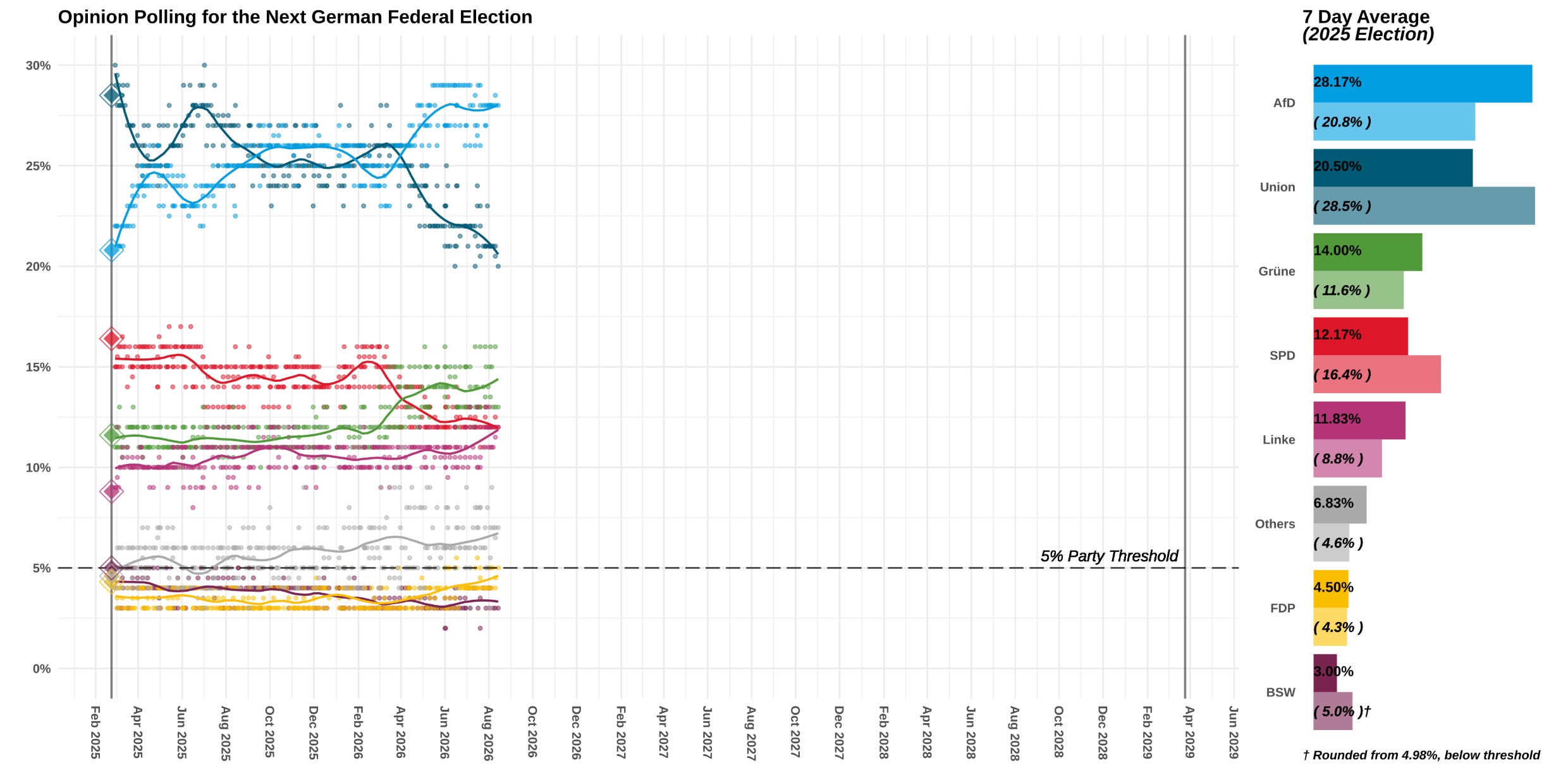
What lies behind all this seems pretty clear to me.
In Germany, as in many other European states, the very deliberate policies of mass immigration, rapid demographic change, and porous borders, combined with what this has enabled, including Islamist terror, have now left millions of ordinary people desperately searching for a political alternative.
Last year, YouGov conducted a major survey and found that people who are planning to vote for the AfD are overwhelmingly concerned with immigration. While more than half of all Germans put migration in their top three concerns, for AfD voters their anxieties about this issue crowded out everything else:
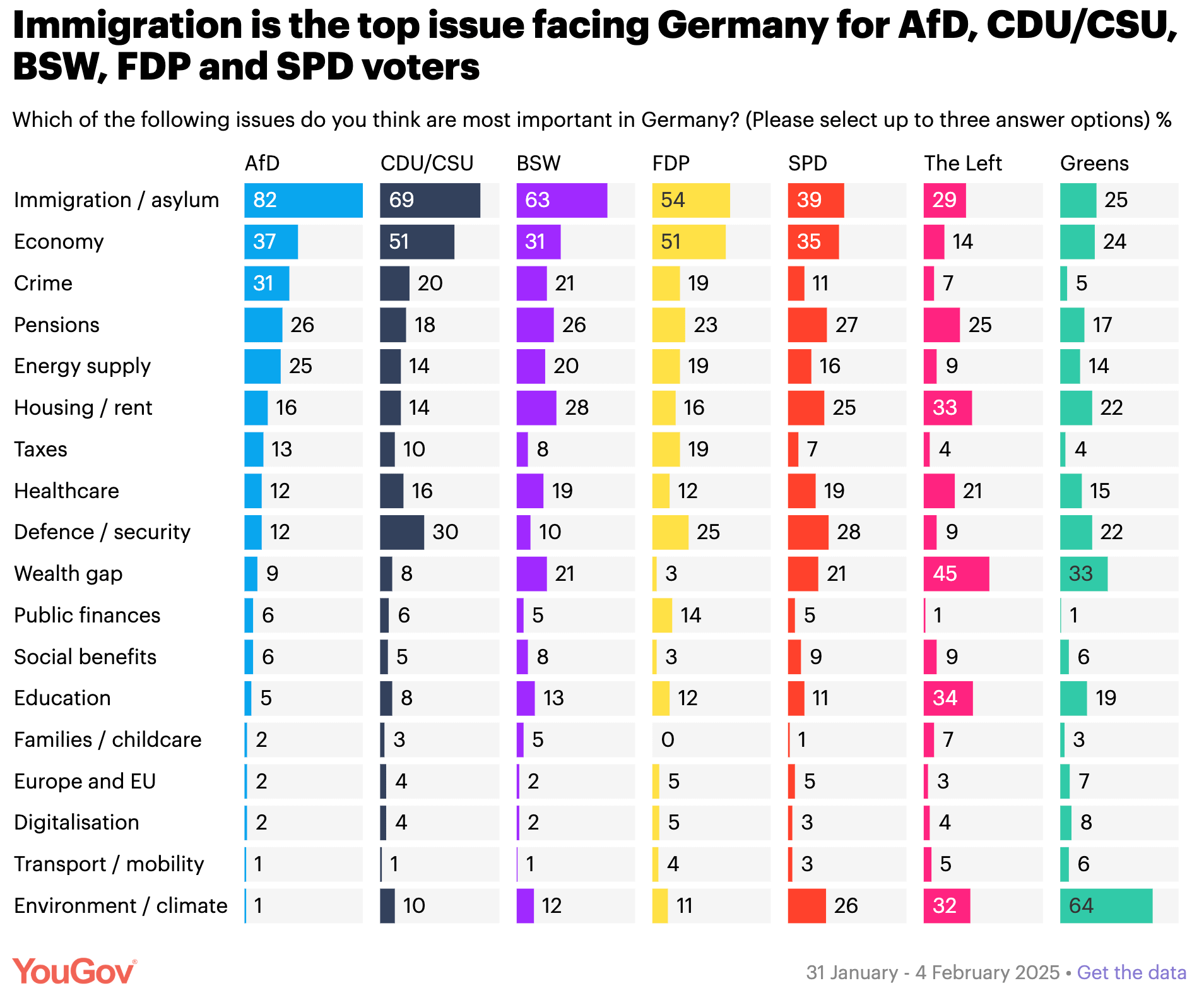
Another major study likewise found that concerns about immigration dominate the minds of AfD voters, alongside their opposition to mass welfare, feelings they are being ‘systematically neglected’, and a belief that the underlying social contract in Germany no longer works for ordinary people.
And it’s not hard to see why so many Germans feel this way. Their anxieties are entirely legitimate, shaped by what is actually happening to their country. In the last ten years or so …