

In early 2016, I walked into a bank in Paris, gave a talk to a room full of investors, and told them the British people were about to vote for Brexit.
They laughed in my face.
I thought the Brexit campaign would win the referendum because unlike its Remain opponents it understood what would get people to the polls.
Remainers, like boring bank clerks and technocrats, spent the entire campaign endlessly warning people about jobs, growth, recession, and economic risks.
Brexiteers, in contrast, spoke directly to people who wanted a genuine say over their own laws, their own borders, their own democracy and, ultimately, their own lives.
Plenty of those people understood Brexit would be economically risky. The key point — which Remainers missed — was that many were willing to take these risks if it meant they could have more influence and control over their own country.
The Brexit campaign also had other advantages that were missed at the time.
Leavers were significantly more likely than Remainers to say they would turn out and vote — not just because they were older but because they were more enthusiastic.
They knew this was their only chance to overturn a political project that had been imposed on them by both Labour and Tory governments since 1997 — pro-EU, pro-middle class, pro-immigration, pro-London — and they seized it with both hands.
The undecided and apathetic non-voters — excluded from headline polling figures — also leaned instinctively towards Brexit. They didn’t like the EU. They thought immigration was out of control. And they didn’t trust the Westminster class.
Remainers were outflanked because about three million of these people suddenly turned out to vote and six in ten of them voted for Brexit.
Fast forward a decade and I was thinking about that meeting in Paris this week, while watching Labour Prime Minister Andy Burnham unofficially launch the campaign to rejoin the European Union.
Rejoining, he said, would be “unthinkable” without giving the British people a vote. Which either means Burnham has just opened the door to a second referendum, or Labour’s about to put rejoining the EU into its manifesto at the next general election.
I suspect it will be the latter because much like I told that meeting in Paris I cannot see how Rejoin could ever win a referendum.
Like Remainers in 2016, Rejoiners have spent much of this week telling anybody who will listen that the people and the polls are on their side. Yet while Andy Burnham, Sadiq Khan, David Lammy and Ed Davey have all made this argument, it’s not true.
If you ask people a straightforward ‘Rejoin versus Stay Out’ question, then the polls do suggest that Rejoin holds a healthy lead of between 13 and 26 points. But these polls also completely ignore the question that will define this battle.
Rejoin what? The single market and the customs union? Free movement and unlimited immigration? Paying tens of billions into the EU budget? Adopting the Euro single currency?
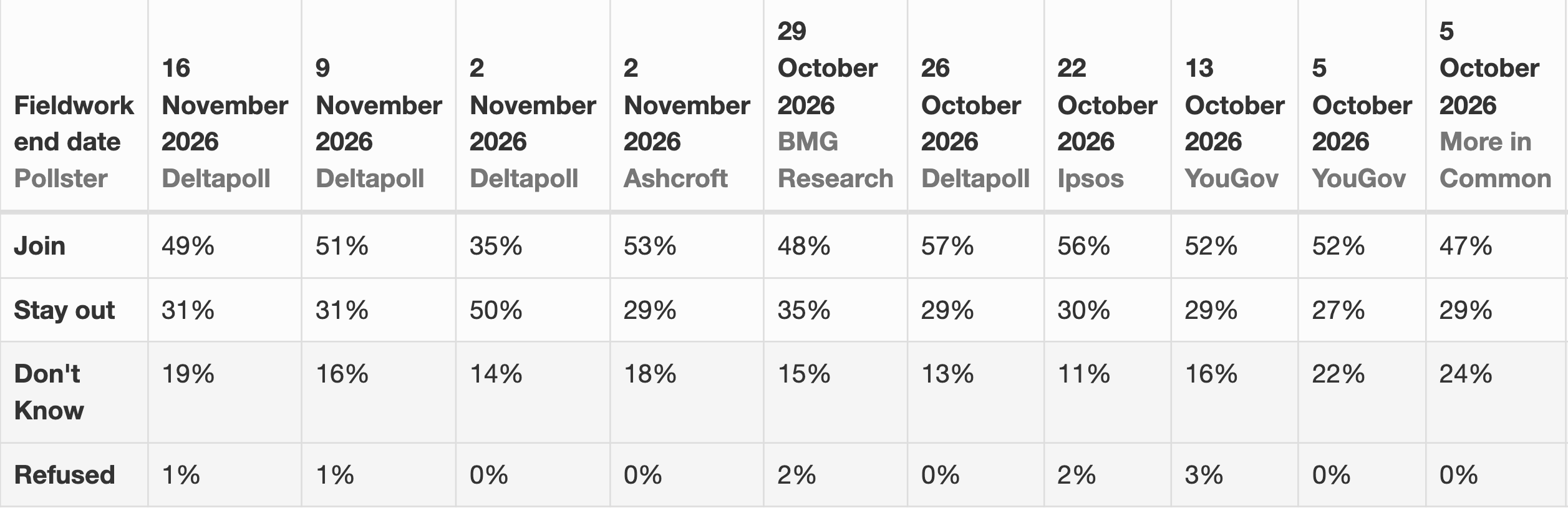
This question is critical because once you look past the headline figures and actually ask people to think about what rejoining would entail their support falls off a cliff.
When pollsters Opinium recently presented voters with all of the possible options — rejoining, stay out with a closer relationship, stay out with a more distant relationship, or keep things as they are — support for rejoin crashed to 36 per cent.
Not even Remainers are passionate about the cause. Only 59 per cent of people who voted Remain in 2016 say they want to Rejoin the EU today, while the vast majority of Leavers, 85 per cent of them, want to Stay Out in one form or another.
YouGov find the same. Once the favourable terms or ‘opt-outs’ that Britain enjoyed during its past EU membership, including a big discount on payments into the EU budget, are removed (which they inevitably will be given that the EU could never be seen to give Brexit Britain more favourable terms than its own EU states), then support for rejoining once again collapses.
Tell the British people they’ll have to rejoin the single market, the customs union, accept free movement, adopt the Euro, and have to pay just as much as everybody else into the EU budget then only 35 per cent of them say they’d support rejoining.
Rejoiners like David Lammy and Sadiq Khan like to think they represent a new majority but in reality they only represent about one-third of the country.
And while they claim the British people have turned against Brexit — which is true, 63 per cent now say Brexit has been ‘a failure’ — they never tell you why. This outpouring of Bregret is not simply being driven by a mass army of voters who loathe Brexit and now see their future in rejoining the EU.