

Matt Goodwin’s newsletter goes to 94,000 subscribers. Inner Circle and Paid subscribers can access every post, the full archive, the comments, join Matt live every Friday, and know they are supporting an independent writer who speaks up for the silent majority. Join us on YouTube, Instagram, TikTok, X and Facebook. We will always tell you truth. Support us by upgrading or donating.
TONIGHT. Inner Circle and Paid Subscribers are invited to join Matt Goodwin LIVE on the Substack App for an exclusive discussion about his new book and the reaction to it on Monday, March 30th, at 18.00/6pm UK time. See you tonight!
Aside from watching my new book Suicide of a Nation rocket to Number 2 in the Amazon bestseller list - making it the second biggest selling book in Britain behind a children’s Easter book about a fluffy chick - I also spent this weekend watching something else.
Mounting evidence that Britain is about to be plunged into a major financial and political crisis, which could clear the way for an early general election.
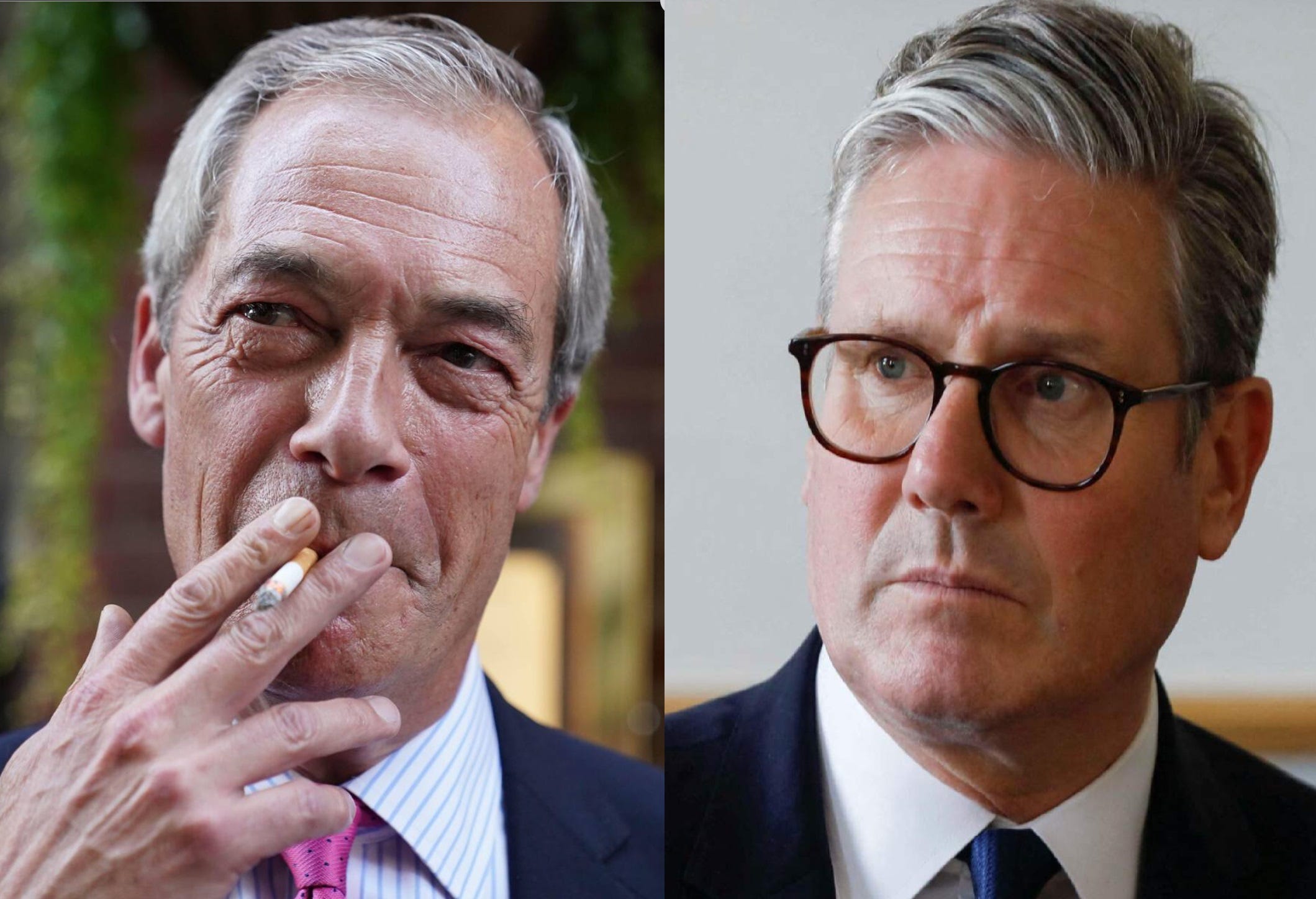
I remember Nigel Farage telling me six months ago that he thought the next general election could arrive much sooner than 2029, potentially as early as next year.
I was sceptical.
But now, amidst the ongoing War in Iran and an intensifying energy crisis, I not only think Farage was right but am also coming to the view it could arrive even sooner.
Just look, for example, at the clearest warning sign of all: government debt.
Britain is currently spending somewhere around £140 billion a year just servicing our national debt - just paying off the interest on our country’s credit card.
Though you won’t hear much about it in Westminster, Britain is now spending more money each year servicing the interest on our national credit card than we are on things such as education, the Home Office, and even national defence.
It really is a disgrace and reflects decades of political mismanagement.
It is not normal. It is not sustainable. And it is now getting a lot worse.
Because the cost at which the state borrows has been soaring.
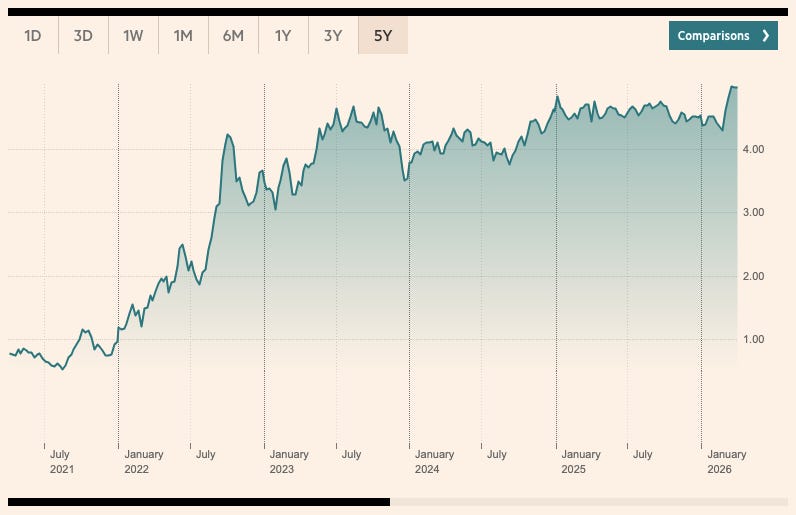
Last week, amid War in Iran, the UK government’s borrowing costs jumped above 5 per cent - the highest level since the global financial crash erupted in 2008.
And, no, this is not happening everywhere.
As one journalist noted yesterday, Britain’s ten-year gilt yields have risen by roughly twice as much as their equivalents in Germany and America, and by more than any other major country in Europe - except Italy. The Greeks can borrow money more cheaply than the Brits, which is really saying something.
Also, put this in domestic context.
When the BBC, Westminster, and much of the ruling class had a complete meltdown about the frenzied reaction to Liz Truss’s infamous budget, in autumn 2022, the rate was 4.54. Today, it’s just short of 5 per cent.
Yet where is the same meltdown?
In fact, the rates have consistently been higher than they were during the Liz Truss era for a long time. Back then, in 2022, we were repeatedly told the soaring cost of our debt represented a major and unique loss of market confidence in the economy.
Things could not possibly go on, they said. There must be a change of direction. There must be new leadership. So, if that was a crisis - then what is this?
Britain is currently nearly £3 trillion in debt - £3 trillion. And the blunt reality is that we are simply too weak to carry this amount of debt comfortably.
Our country is now trapped in an ever-tightening economic ‘doom-loop’ - with low or non-existent rates of growth and productivity resulting in high spending, high borrowing, the highest tax burden since World War Two, soaring energy prices that are fuelling stubbornly persistent inflation, and the spiralling cost of managing our very large pile of debt, which is making everything worse.
It is genuinely difficult to see how we get out of this.
Things were bad before the War in Iran; but now soaring energy bills, as a result of those supply chain shocks, are pushing us ever closer to a major financial crisis.
Last week, the consultancy Oxford Economics predicted that the British people’s household energy bills, already at historic highs, will surge by another 14 per cent from July, as higher oil and gas prices filter through to the domestic economy.
Because our hapless leaders in Westminster, captured by the Net Zero religion, refuse to make use of our own oil and gas supplies, we have become deeply and dangerously exposed to international fluctuations in energy prices, leaving our economy and the British people extremely vulnerable to any and every external shock.
Meanwhile, next month, the British people’s council tax, water, mobile phone, Internet, car tax, and even the cost of passports and stamps will all rise, too.
It really is not hard to see how this mounting financial crisis could soon push us into a major political crisis, too, colliding with trends that are already visible.
Keir Starmer’s Labour government is imploding. It’s not just that the prime minister is in office but no longer in power, as everybody can already see, from one backbench Labour rebellion to the next, from the departure of one advisor to the next.
It’s that the structural foundations that underpin the Labour Party are also rapidly giving way, setting the stage for even more political chaos.
I was pleased to have played a small role in this, defeating Labour as a Reform candidate in Greater Manchester, in one of their strongest heartlands.
Losing to the Greens and Reform in Gorton and Denton not only forced Labour MPs to acknowledge their party’s weakness but revealed how the deeper tectonic plates in British politics are now also on the move.
Our entire political system is now rapidly fragmenting, with the two old parties, Labour and the Tories, facing unprecedented pressure from a new politics.
Look, too, at the national polls.
Keir Starmer is not only the most unpopular prime minister since records began, and incredibly unpopular among his own Labour MPs; but public support for the Labour government has also collapsed, reflecting a broader loss of confidence.
In recent days, Labour slumped to 16 per cent with pollsters Find Out Now, 15 per cent with Verian, and 19 per cent with YouGov. These are truly dismal numbers.
More than one in three Labour voters have now fully decamped to other left progressive parties, mainly the Greens, while Labour is now also being taken apart by Reform in its working-class heartlands.
Alongside the looming financial crisis in the markets, this mounting political crisis will also intensify as we head towards a crucial set of local elections, on May 7th.
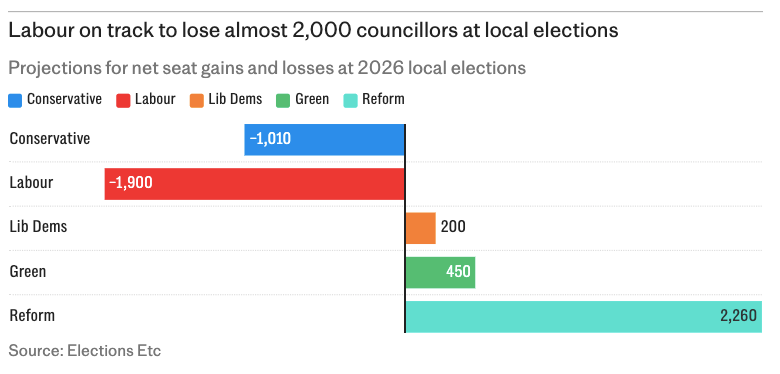
According to one academic forecast this week, Labour will lose nearly 2,000 local councillors - more than three in five that are up for election - while Nigel Farage and Reform will gain more than 2,200 and the Greens make modest gains.
It is difficult if not impossible to see how Keir Starmer hangs on after these losses.
Yet it is just as difficult to see how a successor to Starmer from within the Labour ranks, say Angela Rayner or Wes Streeting, would make much of a difference.
Financial markets do not just look at numbers; they look at political stability and the extent to which a government is able to take difficult decisions and do what needs to be done to deal with the underlying structural weaknesses in the economy.
If and when Starmer goes, the markets will inevitably demand major cuts to spending and borrowing, while many will call for a radically different approach to energy.
But none of this will be accepted by the vast majority of Labour MPs who, now faced with a populist Green opponent on their left-wing flank, will firmly oppose what they will no doubt call “austerity” and see as a climbdown from their Net Zero fanaticism.
Amid this chaos, I do not think it is entirely impossible that many Labour MPs will simply conclude that it makes more sense to bring down the Starmer regime and even go to the country than be seen by their own constituents, friends, and family to have to oversee a “right-wing economic agenda” they firmly oppose.
While the next general election does not have to be called until summer 2029, I just do not see how we continue along this path for much longer without the financial markets, alongside voters, calling time on not just Starmer but the Labour government.
Weak growth. Soaring debt costs. Repeated external shocks. And Labour politicians who are obviously unable to inspire public confidence and trust.
Put all these things together and you have the ingredients for something far more serious than a routine downturn or a “difficult set of local elections”.
You have the beginnings of a full-blown systemic crisis. A collapse of public confidence and public trust in not just a prime minister but an entire system.
And when that happens - triggered, for example, by the reaction to an auction in the financial markets, another spike in energy prices, a surge of inflation, another set of dismal growth figures, or a political crisis in and around Number 10 - then things will start to move very, very quickly and much faster than many people expect.
This is why I genuinely believe that an earlier-than-expected general election is already leaving the realm of speculation and entering reality. All the warning signs are flashing red. We are hurtling towards a financial crisis. Our economic model no longer makes any sense at all. And it is not hard to see, in the coming weeks or months, how the markets decide to call time on the Labour government.
As I said at the outset, when Nigel Farage took the stage at a conference last year and predicted a general election as early as 2027, I told him I was sceptical. I just couldn’t see the path to one. But now, I think he was, once again, ahead of the curve …

Inner Circle and Paid Subscribers are invited to join Matt Goodwin LIVE on the Substack App for an exclusive, final discussion about the book and reaction to it tonight, March 30th, at 18.00/6pm UK time. This will be our final discussion point before moving on to other topics. We hope to see you there!
I hope you're right. Since Summer 2024, this endless waiting for the "excrement to impact the rotary ventilation system" has been excruciating. Just watching everything - on all fronts (economy, freedom of speech, civil liberties) - getting worse and worse; trying to protest to my MP but she's not listening.
This "government" are determined to double down on their crazy track, they're away from reality. Can't collapse soon enough.
I hope you’re right but disagree. This government knows they are done for, but lack any ounce of decency and will hang on until 2029, the turkey’s will not vote for Xmas .
They are now on a scorched earth strategy to complete everything they want to do regardless of what the public want, and will leave the biggest mess possible for Reform to sort out.