What the removal of Churchill is really about
The latest symbol of a wider war
Matt Goodwin’s newsletter goes to 94,000 subscribers from 183 countries. Inner Circle and Paid subscribers get access to all posts, the entire archive, events, comments, and help us spread our message. You can join us on YouTube, Insta, TikTok, X and Facebook. We will always tell you the truth.
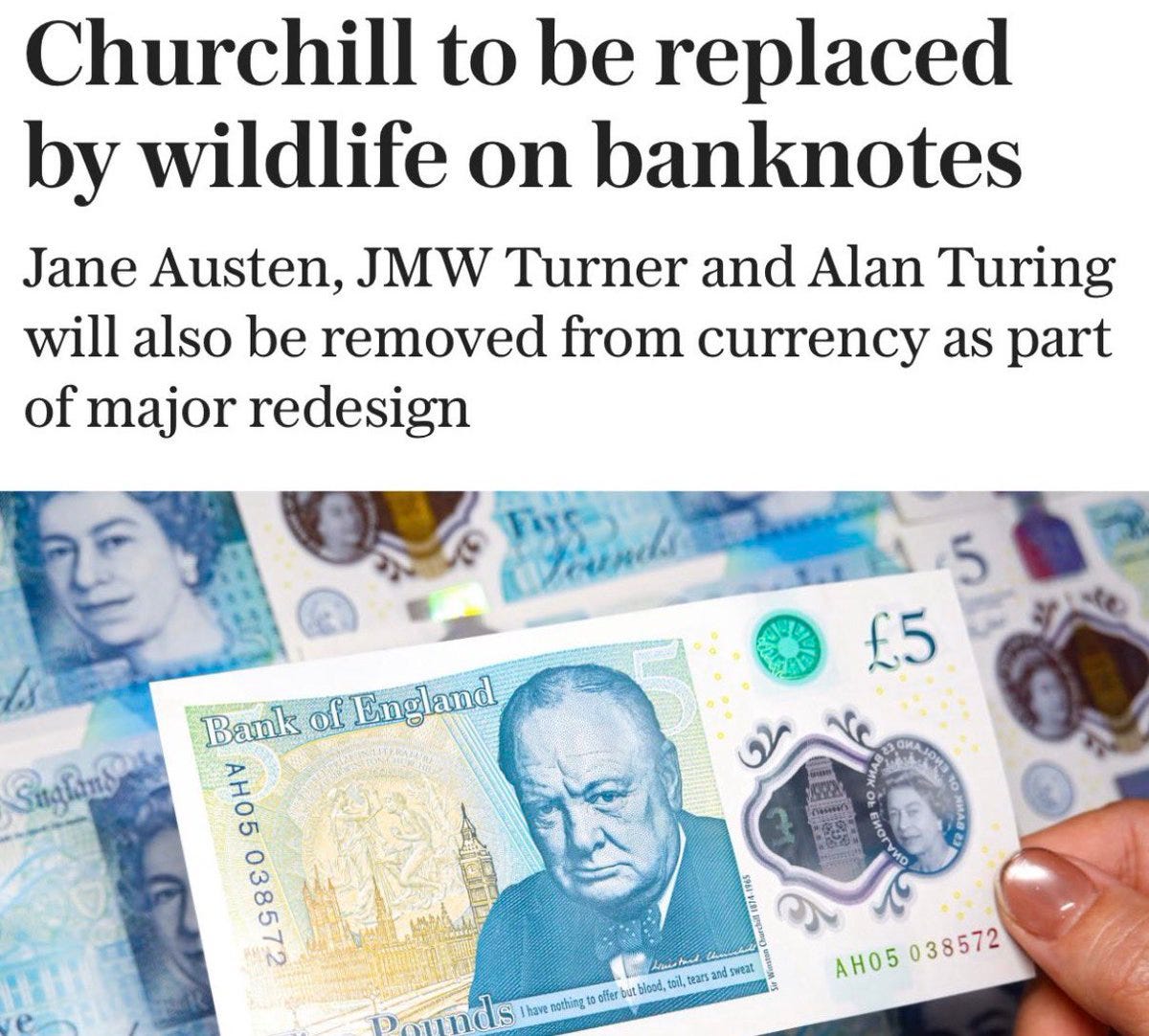
Here’s a story that did not receive the attention it deserved this week — but it really matters. The Bank of England is removing historical figures such as Winston Churchill from banknotes and replacing them with images of wildlife or landscapes.
If the decision goes ahead then Churchill — the wartime prime minister who led Britain through its darkest hour — will soon disappear from one of the most recognisable symbols of our national life.
To some people, this may appear like a minor design change.
A trivial story.
But it isn’t. And it matters far more than many people realise.
Because what we are witnessing today is not a debate about the design of banknotes. It’s part of something much deeper and more insidious: a slow but relentless erosion of our national culture, identity, and sense of collective memory.
As I wrote nearly two years ago, across the West we are now living through what Professor Frank Furedi has called the ‘War Against the Past’.
Increasingly, a loose alliance of bureaucrats in thrall to the ‘Diversity, Inclusion, and Equality’ agenda, radical left activists, and compliant public institutions are pursuing a cultural project that seeks to delegitimise our history and heritage, and strip away the symbols that once anchored our sense of collective identity and memory.
The pattern is now familiar.
Statues are toppled. Historical figures are reframed as morally suspect or “divisive”. Public institutions rename their buildings, spaces, even London Tube lines.
School and university reading lists are “decolonised”. Netflix and other media revise or reinvent our historical dramas and disrupt our sense of continuity with the past.
In this way, our past is rewritten to emphasise only its sins while ignoring its achievements, while our sense of history is reframed so it becomes less about who “we” are as a distinctive people and much more about the celebration of others through a relentless obsession with “diversity”.
Even the quiet symbolism of everyday life — the images on our currency, the names of our streets, the monuments in our squares — is steadily edited and sanitised.
What replaces these symbols is rarely anything meaningful.
Instead of historically significant figures who helped shape our nation, we are offered neutral, value-free, universal imagery that stands for nothing at all — landscapes, wildlife, abstractions.
On the surface this might appear harmless.
But symbolism matters.
For centuries, historical figures served as cultural signposts, reminders of the history, struggles and achievements that shaped the nation and our ancestors.
Remove those signposts, and something subtle but important begins to change. The past becomes distant. Then contested. And then, ultimately, disposable.
Gradually, the story of our nation, the story of our home — our collective triumphs, failures, and defining moments — is hollowed out.
And in its place emerges a new and very different idea of national identity that is deliberately thin - one that defines the British and the English not through our actual history and traditions but the abstract celebration of universal diversity.
In other words, the only thing that is meant to define our identity and history is that we have no distinctive identity or history at all.
All we are, all we have ever been, is a dot on a quilt of universal globalism.
It is all part of what Furedi calls the ‘war against the past’, as I summarised in 2024:
“Cancel culture, Furedi argues, has now moved from focusing on the present towards imposing its narrative on how we view our past and history.
The goal of radically revising if not cancelling our cultural inheritance is pursued by reorganising society’s historical memory and disputing and delegitimating its ideals and achievement …
At the root of this is not just the elite’s desire to repackage our identity around a universal liberal celebration of diversity and multiculturalism but a conception of ‘asymmetrical multiculturalism’, whereby the British and the English are now told to celebrate the distinctive identity, history, and culture of minorities while told to forget, downplay, or criticise their own distinctive history and identity”.
The endpoint of this cultural project is not inclusion but historical amnesia, or cultural erasure. What we are left with is a nation that is fully detached from its past, uncertain of its traditions, and unsure of what binds its people together.
Furedi is by no means the only person to point this out. Sir Roger Scruton referenced the same process when he said: “A society that loses its memory loses its identity.”
That loss does not happen suddenly.
It happens gradually, through thousands of seemingly small decisions — a statue removed here, a curriculum altered there, a historical figure quietly replaced on a banknote.
Each individual change may appear insignificant. But taken together they represent something far more profound: the slow disconnection of a people from their own history, ancestors, and collective memory. A people who no longer really know who “we” are. A people who become fully disconnected from themselves.
I doubt that the bureaucrats who made this decision at the Bank of England fully grasp the cultural significance of what they are doing. But intention is not the point. The effect on our society and culture is what matters.
When we remove the symbols of our past, we weaken the foundations of our identity. Or as George Orwell likewise warned: “The most effective way to destroy people is to deny and obliterate their own understanding of their history.”
This is what is happening and accelerating around us. This is what Furedi means when he talks about the war against our past. And this is why the latest symbol of this war really does matter.
Not because of one banknote.
But because of the much larger cultural battle that it represents.
If you value analysis like this — if you want to support independent writing that challenges the cultural orthodoxies of our time and ensure we can spread our posts to millions of other people through our team and social media — then consider becoming a paid subscriber.


I hate them all so bloody much, the people doing this to us. It’s as if someone is pouring acid on what once was the most wonderful country and culture and is laughing to see it all dissolve in front of our eyes. Sorry to be melodramatic but I just hate it all.
Tragedy beyond comprehension to not stop this madness in its tracks