

Nearly 100,000 people follow this newsletter for counter-cultural evidence and analysis about what is really happening. Become a paid supporter to unlock every article, every episode of The Silent Majority podcast, every live discussion, and every group chat — while supporting a platform that speaks up for ordinary people and tells them the truth.
Here’s something you might have missed.
Buried in The Sunday Times last weekend was an extraordinary report about the rapidly changing face of Britain’s grammar schools.
The headline finding was shocking enough: the share of grammar-school pupils who are white British has collapsed from 66% to just 44% in only ten years.
But look beneath the headline at what’s taking place in individual schools and the picture becomes even more striking.
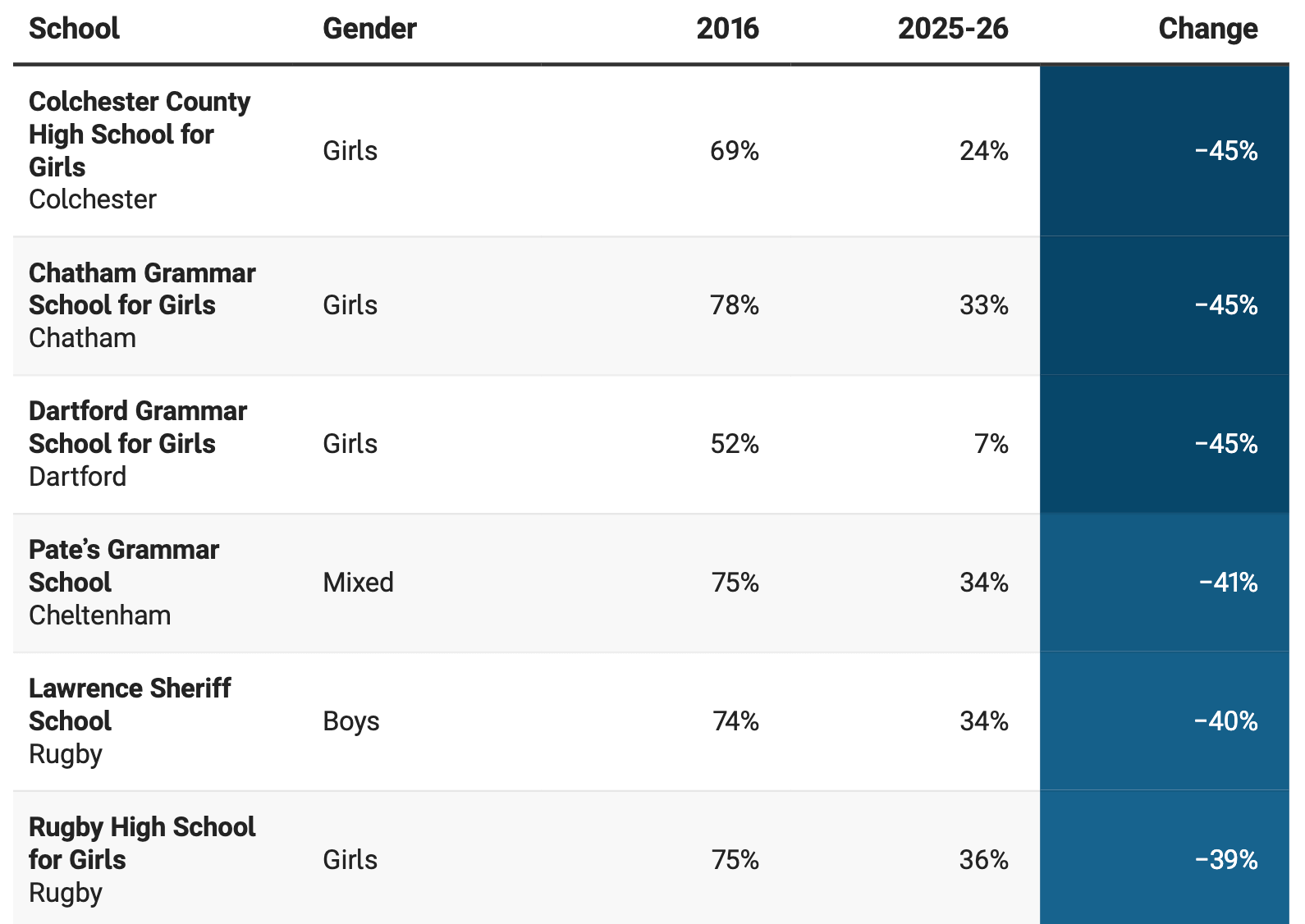
At Colchester County High School for Girls, the share of school pupils classified as white British has collapsed from 69% in 2016 to 24% today.
At Chatham grammar school, it’s fallen from 78% to 33%.
And at Dartford grammar, it’s slumped from 52% to just 7%, while the share of African and Indian pupils has more than doubled, to 37% and 15% respectively.
Headteachers have put forward various theories.
Higher aspirations among first and second-generation immigrant families. Differences in the willingness of families to relocate for a grammar school, or send their children on long commutes. And the schools themselves deliberately targeting minority students, for example by holding large Diwali festivals.
But what this really shows — I think — is the sheer scale at which Britain’s population is now being completely transformed by a demographic revolution that very few people in the country ever asked for.
Just look at the wider trends.
As I pointed out in June, for the first time in British history, the share of pupils who are white British in all types of school — not only grammar — has fallen below 60%.
In Blackburn, it’s 38%. In Manchester, 28%. In Birmingham, 23%. In Leicester, 19%. And in Luton, it’s 13%. White British children are now already a minority in state nurseries, representing just 47% of all toddlers.
Such changes help to explain why, in 2023, the name Muhammad officially replaced Noah as the most popular boy’s name in England and Wales.
Recently, researcher Charlie Cole highlighted many of the same trends, pointing out in Pimlico Journal how demographic changes people wrongly think will impact Britain in the future are already transforming its schools today.
In state primary schools in England, the share of white British pupils has collapsed from 80% in 2003, to below 60% today, with a near-identical fall in secondary schools.
There are already 142 parliamentary constituencies in England where white British children make up less than half the enrolment. In some areas, like East Ham, it’s 2.3%.
As some readers will know, all of this is entirely consistent with what I set out in my book, Suicide of a Nation, which tracks the demographic transformation of Britain in detail and shows where our country will soon be if we do not change course.
As I wrote, if you really want to see the future of a nation then don’t just look at the official census. Look at its schools and nurseries:
“In 2001, the white British made up 83% of all children under four; by 2021, it was 66%. Two years later, in 2023, barely half of all babies born in Britain were white British — down from 65% a decade earlier.
White British children are already a minority in one in four schools in the country, including almost all of London. Nearly four in ten schoolchildren now come from minority ethnic backgrounds, a ten-point surge in just ten years.
There are many schools where where British children are barely visible at all. In 2006, there were some 760 schools where they made up fewer than one in ten pupils. Today, that number has surged to 1,400.
Astonishingly, there are nearly 500 schools where white British children make up less than 2% of pupils, and 72 schools where not a single white British child appears on the register.
In state nurseries, the trends are even more striking. White British toddlers now make up only 19% of nursery pupils in Manchester, 16% in Nottingham, 14% in Luton, 13% in Bradford, 12% in Kirklees, 8% in Coventry and just 5% in Slough.
Not everybody wants to talk about what is happening. Many people in our media, universities, and politics would rather shut this conversation down altogether.
When I shared the latest figures highlighted by the The Times on social media, I was promptly attacked by many on the political left, including former columnist David Aaronovitch, who suggested merely talking about this is “straightforward racism”.
But they are wrong.
Because demographic change on the scale we are witnessing in Britain, symbolised by what is unfolding in schools, really does matter. And so too do majority groups.
Contrary to what many left-wingers and liberals like to think, nations are not simply blank economic zones that are populated by interchangeable groups.
Nations are historic communities that have been built over generations by a historic majority. And it is this historic majority that gives a nation its language, institutions, customs, memories, traditions, ways of life, and much deeper sense of itself.
Over generations, the history, symbols, and traditions of the majority become deeply entwined with the nation itself. They provide what we might call the “cultural architecture” around which a shared sense of identity, familiarity, and community develop, and into which some newcomers — at a manageable pace — can integrate.
What left-wingers and liberals routinely ignore is that without this shared sense of identity and familiarity — or without the shared sense of “we” on which a nation depends — then things like the welfare state and other redistributive policies would soon break down. If people do not feel a bond to a shared community, which finds its expression through the historic majority, then they will simply withdraw, hunker down, and nbecome much less trusting of others.
In 2020, a major academic study that analysed the findings of nearly 90 other studies concluded there is a ‘statistically significant negative relationship’ between ethnic diversity and trust — meaning more diverse nations are ones where people become less trusting of others. This is the future the political and media class is now pushing us towards — a low-trust Britain where people break off into competing groups.
People like David Aaronovitch find it easier to scream “racist!” than engage with these findings. What they also ignore is that minorities value and recognise the importance of the historic majority, too, which they see as a symbol of the nation.
That’s why close to one in three people from a minority background recently told one pollster they also ‘feel like a stranger’ in Britain because of the sheer scale of mass immigration, which is rapidly eroding this deeper sense of familiarity and belonging.
Another person who has shown this is Professor Eric Kaufmann who, in his brilliant book, Whiteshift, not only shows how minorities feel strongly attached to the historic majority but that nations which do not have a clear majority become far more prone to fragmentation, sectarianism, and polarisation — all of which is already starting to become visible in a rapidly diversifying Britain. Growing evidence of sectarianism, fragmentation, polarisation, and a collapse of public trust all lie downstream from the onset of mass immigration and rapid demographic change.
Clearly, this does not mean the historic majority must remain frozen in time, or that a nation should have no immigration or change whatsoever. Rather, Kaufmann’s argument is that coherent nations with a clear majority are much better able to absorb a small and manageable number of newcomers while retaining a sense of continuity and familiarity through the myths, symbols, traditions, and culture they inherited from previous generations. In the end, nations with a clear majority are stronger and more stable than those without.
The crucial distinction is between a nation that changes while maintaining a recognisable and stable centre, and one that fragments into increasingly separate communities with no sufficiently powerful identity holding them together.
Look, for example, at Lebanon or Sierra Leone, neither of which have a clear majority and both of which have descended into intense ethnic, religious and regional conflicts. Is this really the path we want to push Britain down?
The key point, which is reflected in those new school figures this week, is that the rapid decline of Britain’s historic majority will soon take place across the country and will be a profound, unprecedented and unpredictable moment.
It is a moment that deserves serious discussion, not least in Westminster where the vast majority of establishment politicians are unwilling to discuss it at all, and among our media class and commentariat whose supposedly superior insight delivers the sophisticated response of: “it’s racist to even talk about it”.
These are simply not serious people. If they were, they would be offering a serious response to the questions that everybody now seems to be avoiding.
What is going to happen to the shared national identity, history, culture, and way of life in our country when its historic majority slides into minority status? What exactly is going to hold radically different ethnic, religious, and cultural groups together?
And what will happen to our sense of history and collective memory when most people living in Britain, by the 2060s, will only be able to trace their roots on these islands back only one or two generations at most?
You cannot answer these questions merely by pointing to GDP or to the fact that people hold the same passport. The real question is what will bind us together, what historical story will we share, and how will a Britain characterised by mass migration and relentless demographic change generate the deeper sense of mutual obligation, trust, and responsibility that makes the welfare state, the social contract, and even our democracy possible to begin with?
These are not “racist” questions. They are questions about nationhood and belonging, which happen to be the only things that have enabled human-beings to organise themselves into coherent and relatively stable communities.
That is why these numbers matter. They are not just showing us some kind of hypothetical Britain that might emerge in the decades to come. They are showing us a version of Britain that is already emerging around us — in our schools and nurseries.
And while Westminster remains silent, and members of the media class try to shut down any discussion, the British people deserve to be able to talk about it. And I for one will never stop talking to them about what is happening in their own country.
Our paid supporters have access to live discussions with Matt, full episodes of The Silent Majority podcast, and every single post. Upgrade to support our work. OUR NEXT LIVE DISCUSSION TAKES PLACE TONIGHT (WEDS) 7PM ON THE APP.
It is truly shocking, we are well on the way to losing our country without a murmur from either Labour or the Conservatives. Are the pupils at Colchester High School there truly on merit or on preferential racial grounds? It seems to me to be incomprehensible that the Governors or staff of the school can be entirely happy about the situation. We are losing our country and we need to vote Reform to get it back: no other party even recognises the problem.
Culture is downstream from race and ethnicity.
We are living through a civilisational changing moment.
It's Remigration or balkanization.
Political parties have to be honest if they are going to go for mass deportations or not.
We can't keep falling for containment/ words and no action.
If we don't have a government committed to Remigration we have to start organising now for our collective interests as ethnic English people.
We need our OWN political representation and advocacy. We need to be building our own parties, groups, lobby organisations, media ect for our people now, as the demographics are only going to get worse and worse.
P.S
Everything the BNP, particularly Jonathan Bowden predicted is now coming true.