

A quick note before we begin: as regular readers will have noticed, we’re now reserving more of our content for our paid subscribers who make our work possible. We now reach tens of millions of people every month through this newsletter and our social media. If you value our work, if you want to help our small team speak up for the silent majority, then please support us.
This weekend, I joined a debate about the future of British politics at the Cliveden Literary Festival, where I was asked a question that many people within the establishment stop asking. Should Britain rejoin the European Union?
The debate is back because of what’s happening in Westminster. In recent weeks, Labour Prime Minister Andy Burnham refused to rule out rejoining the EU and blamed Brexit for our economic problems and inability to manage immigration.
Then, last night, The Times reported that Burnham is “leaving the door open” to rejoining the EU without even offering the British people a referendum — a move that opinion polls suggest would be opposed by nearly two-thirds of the country.
At Cliveden, Labour MP Jess Phillips and even our moderator, Emily Maitlis, made the case for rejoining. But my answer was different and direct.
No - we should not.
Rejoining makes little economic and political sense. Taking Britain back in would be another almighty betrayal of the British people that would further weaken our democracy, fuel mistrust, and break the social contract.
Something I’ve always found striking is the extent to which Rejoiners, who claim to be the most globally-minded and politically sophisticated, appear to be completely out-of-step with what is actually happening within the European Union today.
They remain stuck in a 2000s time warp. But anybody who has actually been watching events closely knows that the EU is not the same club that it was in 2016. Far from it. Their comforting image of a stable, united, prosperous, and politically left-leaning or centrist organisation simply no longer exists.
Somehow, the same Rejoiners who are seemingly horrified by the return of Nigel Farage and the direction of British politics have not noticed how, over the last decade, the EU has become even more more volatile, populist, and restless than Britain.
Openly nationalist and instinctively Eurosceptic parties are not just on the rise but leading many more EU member states than they were a decade ago. Today, they’re leading the polls in Germany, Austria, Italy, Romania, and Portugal, among others.
Politics is also moving rightwards in Spain, where recent scenes of border chaos in Ceuta were transmitted across Europe — including to voters in Britain who are far more sceptical of immigration today than they were in 2016. In France, similarly, it’s not just plausible but likely Marine Le Pen will be the next president, helped by the fact that nihilistic violence, stoked by left-wing parties, is now ravaging the country.
Wherever one looks — from the Alternative for Germany winning state elections to mass protests in Spain, chaos in France, and unrest spreading to Belgium — the social contract across the EU appears to be teetering on the verge of collapse. The EU does not look stable. It does not like secure. And it does not look particularly enticing. The EU that the likes of Emily Maitlis and Jess Phillips want to rejoin is in open revolt.
The legitimate concerns that fuelled Brexit a decade ago — over immigration, borders, sovereignty, identity, and a glaring lack of democratic accountability within the EU - are now rapidly spreading across the continent.
In 2016, Britain’s elite assumed Brexit would push the EU away from conservatism to rally round a liberal progressive, globalist utopia. But they were wrong. If anything, voters across the EU are moving towards the instincts that united Brexit voters.
Just look at immigration and identity.
While Britain’s dogmatic Rejoiners — think Emily Maitlis, Jess Phillips, Rory Stewart, Alastair Campbell — spend their time complaining about calls to restrict and reduce immigration, have they noticed what’s happening in Brussels and Strasbourg?
The EU just approved much tougher rules for immigration returns — including sending migrants who have no right to remain to processing hubs outside Europe.
At Cliveden, Rejoiners were spitting feathers about the Tory party’s ‘Rwanda plan’, which would have seen illegal migrants arriving in Britain processed in Africa.
Do they not know that Greece, Germany, Austria, the Netherlands, and Denmark are pressing ahead with plans to build deportation centres for rejected asylum-seekers in … Uganda and Rwanda? Arguments that were first made in Brexit Britain are now going mainstream across Europe. We were ahead of the curve, not behind it.
In several EU member states, furthermore, such as Austria, France, Germany, and Spain, right-wing parties that are topping the polls or close to doing so want to go even further by advocating a policy of ‘remigration’ — namely forcibly sending migrants back to their countries of origin.
And just last week, the European Parliament backed a motion to add Muslim Brotherhood to a list of banned terror groups, while openly warning about “Islamist entryism” and what is known as “double language”, whereby Muslims speak moderately in public debates but far more radically in mosques.
The political direction is unmistakeable. If one takes a long-term view it is clear the EU is moving away from the kind of globalist utopia Rejoiners want to see.
Nor is the EU an economic rescue boat. Though you won’t hear it during BBC debates that are routinely packed with pro-EU voices, the EU’s share of the world economy is still dwindling.
Even pro-EU think-tanks are documenting the steady decline of the EU’s economic weight on the world stage. Nobody would deny Britain has economic problems. But even so, last year, our economy still grew faster than the EU’s three largest economies — Germany, France, and Italy. What kind of lifeboat are fanatical Rejoiners trying to push us into — one that is already riddled with holes and led by divided sailors?
France, moreover, is now firmly on the cusp of a major sovereign-debt crisis, somewhat similar the crisis that erupted in 2010 and convinced a majority of British voters that the idea that the EU is an economic panacea is a myth.
Borrowing costs have soared. It seems likely this looming crisis, when it erupts, will spread to Italy, if not beyond. And the industrial powerhouse of Germany that Rejoiners remember no longer exists, having been clobbered by its own suicidal energy policy, soaring electricity prices, and failure to match competition from China. The economic argument for integrating with the EU has simply become much weaker today than it was in 2016, when even then most British people found it unconvincing.
There’s no doubt that voters in Britain have turned against the idea of Brexit. Against the backdrop of a political, media, and university class that has spent the last decade consistently undermining the project, it’s perhaps not surprising to find that opinion polls do suggest that most people now think Brexit was the wrong move.
But what the polls also show, and what Rejoiners ignore, is that becoming sceptical of Brexit and wanting to rejoin the EU are not the same thing.
Anybody who genuinely understands how the EU operates will know that were Britain to rejoin then all of our previous ‘opt-outs’ and special benefits would be gone. Losing the pound, having to accept even more EU migrants through free movement, having to accept yet more illegal migrants and asylum-seekers from outside Europe, having to pay many more billions in EU budget contributions, and having to accept many more rules and regulations while having very little influence in return would all, inevitably, be pushed through.
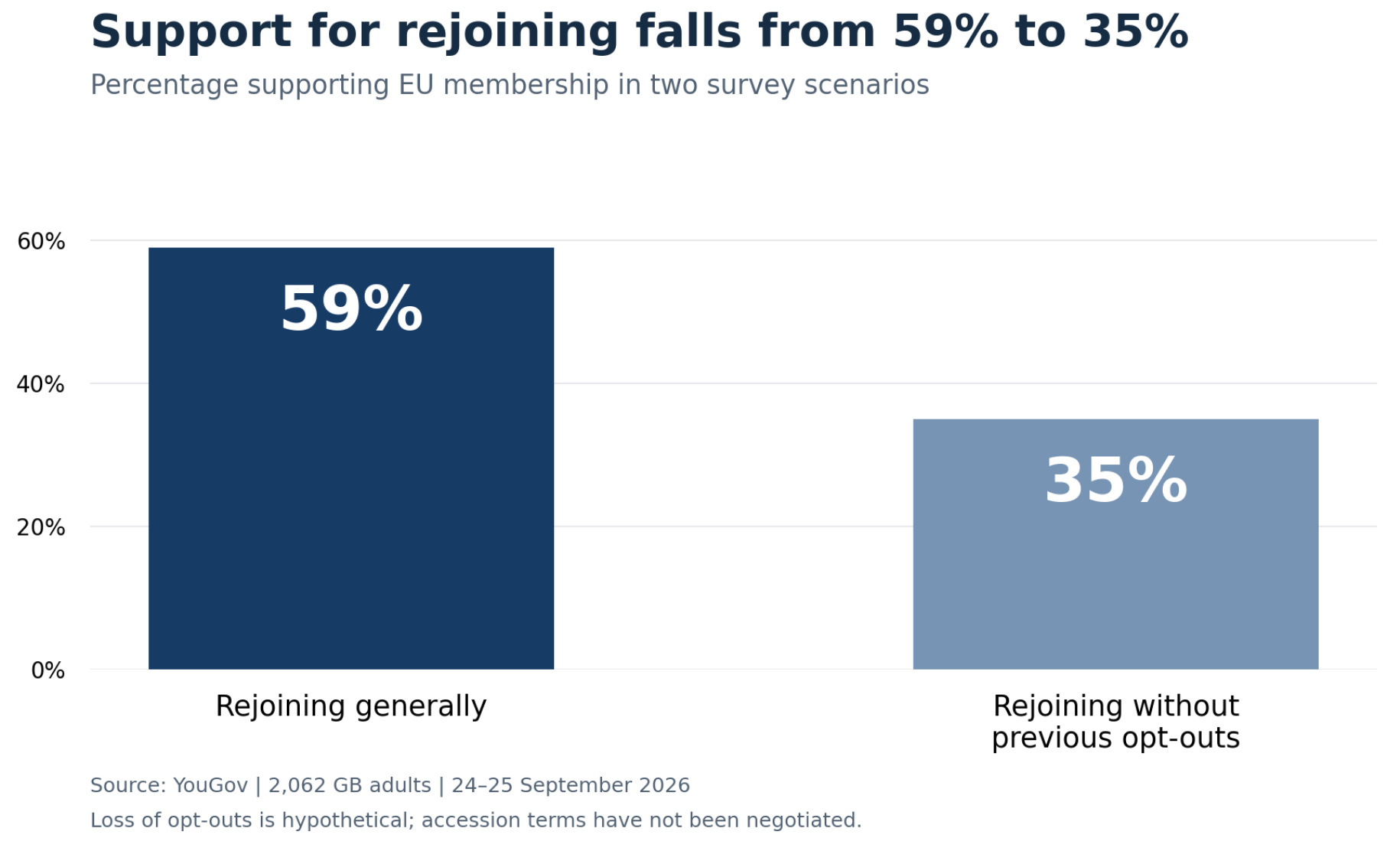
But now look at what the British people make of this. Last month, close to 60% told YouGov they supported rejoining in principle. But when confronted with this reality of Rejoining without opt-outs their support crashed to 35%. And that’s before Nigel Farage, Reform UK, and the country’s Eurosceptic press have even said a word. I simply do not believe Rejoiners would come close to winning a public vote.
Rejoiners will be reduced to the absurd sight of trying to claim that being in the EU would stop the boats. But this argument, too, would fall apart on contact with reality.
In the last four years before Brexit, under the Dublin system, for every one migrant that Britain returned to the European Union it was forced to take nearly four migrants in return.
Rejoiners who claim otherwise are simply lying to the British people. And, unlike a decade ago, the EU now operates a compulsory asylum distribution pact, whereby member states must accept migration or essentially face huge fines.
Just imagine how these facts would play out during a referendum campaign, in front of British voters who are far more sceptical of migration than they were a decade ago.
And then, lastly, comes an extraordinary contradiction within the Labour Party. I’ve already pointed out the absurdity of Andy Burnham promising to give the British people more “power” while simultaneously wanting to send more power to unelected EU bureaucrats in Brussels and Strasbourg, as well as the United Nations.
Burnham talks about wanting to devolve power to the people while also sending it upwards to a highly centralised and undemocratic supranational institution. None of it makes any sense whatsoever.
While I enjoyed listening to Jess Phillips MP make a passionate case at Cliveden for rejoining, I also sat there wondering whether she and other Labour MPs have really thought about the implications for their own political party.
Labour’s raising of private school fees, its independent trade agreements with India, its independent tariff commitments, its sudden fondness for different regulations. None of this would be possible were we in the EU. Does Phillips know this?
Rejoining will lock the British people into an overly bureaucratic, divided, and declining bloc that will strip away their independence, sovereignty, and identity. We will yet again find ourselves locked into endless rules and policies that are decided at the European level and which our national governments, no matter their political persuasion, would be unable to change.
If Rejoiners want to turbo-charge the populist revolt of the last decade that has already upended the establishment in Westminster then openly betraying 17.4 million British people on Europe, only a few years after the Tory party betrayed them on mass immigration, seems a surefire way of doing it.
I’m always among the first to point out that politicians in Westminster managed Brexit disastrously. With the new freedoms Brexit made possible, they should have immediately slashed regulation, taxation and Net Zero costs for British businesses, made our economy far more competitive and prosperous, and replaced the disastrous policy of mass unskilled, low-wage immigration which is hollowing out our economy with much smaller amounts of high-skill migration from compatible nations.
Our leaders, unfortunately, chose to do the very opposite. Brexit did not cause those failures; the political establishment in Westminster did. Which is why, today, the best way forward is not to surrender power and remove our ability to choose a different path but replace that establishment so that we can actually pursue that new path.
At Cliveden, much like in our national debate, the question we were asked was not really about whether we want to rejoin the EU but whether we want to go backwards, retreating into a political and economic union that is very clearly not delivering for its own member states and will not deliver for us.
The question I would have asked is different. When will we finally get politicians who want to go forward — who want to use our new freedoms, opportunities, flexibility, and independence to create a genuinely prosperous, sovereign Britain that controls its own borders and puts its own people first? Because that is what we urgently need.
Our paid supporters join weekly live discussions with Matt, full episodes of The Silent Majority podcast, and every single post. This week’s live will take place on Wednesday at 7pm (UK time) on the Substack App. As usual, it will be posted the following day for our paid supporters who cannot make it. Thank you for supporting us and helping us spread posts like these to millions of people each month.
As the EU disintegrates, due to the Muslim bid for power and the madness of Net Zero, and the subsequent rise of the Right to fight this catastrophe, rejoining will look increasingly like lunacy. Britain would be forced to pay billions of pounds into a bottomless pit in an fruitless attempt to prop-up a power bloc that is intent on committing suicide.
It seems to me that those on the Left are completely and utterly devoid of common sense, and are creating a society that is so weak and feeble that they are consequently opening the door to the enemies of Western democracy, which will see our destruction at the hands of the barbarian hordes, in a fashion that exactly mirrors the destruction of Ancient Rome. Trump is our only hope, not the hideous EU.
They want to pass the buck back to Brussels as they did before…’sorry chaps, we know this is unpopular, but Brussels demands it so it’s out of our hands you see’, terrified of taking ownership of their own mess